Sunday, 2 May 2010

What shall I eat next?

There are two main pastimes in Singapore: shopping and eating. Given that my backpack is already bulging out of its expandable top, I choose eating.

You can eat well and cheaply here 24 hours a day from markets, food courts and restaurants. And with culinary options from China, India and Malaysia (among many others), there’s so much choice it’s hard to know where to begin...or end for that matter.

Here’s a list of what I manage to consume in a day:
-2 slices of toast at the free hostel breakfast
-a bowl of prawn noodle soup
-a cheese and onion Parata – an Indian style pancake
-a fresh coconut (for the juice)
-two slices of melon
-six little Indonesian sweets (made from sago and coconut – a curious mix of sweet and salty, -kind of like jelly and bright green)
-a steamed bbq pork bun
-a very large beer
-roast chicken and rice

All of that costs me the grand total of $20Singapore – that’s around £10 – and all, with the exception of the soup which was a bit bland, was really yummy. It’s lucky I’m only staying one day or I’d be bursting out of my non-expandable top pretty damn soon too.

Around 6pm, when I take a little walk to work off some of what I’ve eaten and build up an appetite for more, Singapore charms me once again.

I stumble on a public square, right in the centre of Chinatown, where a big crowd are indulging in the local version of line dancing. They dance in unison to tunes ranging from the 1950s to last year and can I tell you, you haven’t seen anything till you’ve seen 100 middle aged Singaporeans dancing suggestively to Pussycat Dolls Don’t Cha. ‘Bet you wish your girlfriend was hot like me,’ they sing along, as they bump and grind it.

Some are dressed up (check out the matching cowboy boots, hat and shirt of the couple in the front of the picture) but plenty are just wearing jeans and a t-shirt. They know all the moves to something like 50 songs (I don’t stay that long but I do check out the song list before I go).

They’re dancing in front of an old Chinese temple so I stick my head round there before I wander off. A huge gold sitting Buddha, with a multi-coloured bejewelled halo, casts a benign eye over me. Wisps of incense smoke floats around my head and it feels as though Singapore is blessing my journey.

Friday night Singapore style

Flying into Singapore on a Friday evening is invigorating. On the left of the plane, the city stands confident, bathed in light. Skyscrapers reach glass and steel fingers into the sky. On the right, in the dark bay, a vast flotilla of cargo ships, a hundred or more, form a queue waiting their turn to unload and collect at Singapore’s port. Their lights, flickering red and green resemble a long weekend motorway traffic jam.

The airport itself is a buzz of energy – shops and restaurants are open and busy serving staff and passengers. An orchid garden is signposted on the right, a food court further on. The aircon is cool, the directions clear, everyone is moving.

I find myself in the flow of people heading for the metro system and like neat little bottles on a conveyor belt we ride the escalators then find staff on hand to provide advice, assistance and even small change for the newly arrived.

The trains themselves are new, spotlessly clean, air conditioned and filled with a cosmopolitan crowd. Young super stylish kids play with i-Pods, phones and games, then stand for an old Chinese couple who lower themselves slowly onto their seats. Two Indian women, one in an iridescent sari reminiscent of a peacock’s tail, stand by the doors adding a touch of glamour to the carriage.

It’s midnight when I emerge into the heat in Chinatown, where I’m staying. Everything is open – stores, restaurants, bars. Music beats loud from storefronts and there’s a smell of incense in the air. People are browsing, eating, shopping, chatting; all calm, all relaxed, not a drunk or a burger wrapper in sight.

I think of what the same experience might be like arriving into Heathrow late on a Friday night and the contrast is a little shaming.

Saturday, 1 May 2010

The Tiwi Islands

Bathurst Island sits, jungle green, in the turquoise sea. Along with Melville Island, just across the water, it is the traditional home of the Tiwi people and remains an indigenous community that outsiders are only allowed to visit with permission from the traditional land owners.

The ferry from Darwin, an hour away to the south, slows as it approaches, then winds its way up an estuary lined on both sides with deep mangroves and, to my mind, the bulbous watchful eyes of large crocodiles.

It anchors off shore and a small boat bounces out to meet us. We clamber on and, spray in our faces, motor towards the beach, sliding onto the sand with surprising speed. The ferry terminal is a large shed brightly painted in the local style: red, yellow and white ochre whirling in gentle patterns.

Phil has been sent to meet me and drive me the 80km to the outstation of Ranku where I’ll be staying. But first we check out Nguiu, the capital. Home to 1,500 people it has a slightly desolate air. Gardens are overgrown, litter is caught in the long grass, skinny mangy dogs yelp as they chase the tyres of our Landcruiser. On vacant lots and in gardens, groups of people sit in circles on blue tarpaulins under the trees, concentrated and engrossed. Children weave among them, most holding large bottles filled with vividly bright soft drinks.

‘The 3 G’s,’ says Phil when I ask what they’re doing. ‘Gambling, ganja and grog.’ Alcohol is severely restricted but marijuana use (despite its illegality) is a growing issue. And gambling is a favourite pastime. Each blue tarp is a mini casino where a game of cards, sometimes with stakes in the thousands, is taking place. ‘Whoever provides the tarp, along with a tap for water and maybe access to a toilet gets $400 a day,’ says Phil. ‘I’ve heard of people winning $15,000a game. It’s big money.’

We pull up to visit an artists’ collective locally known as ‘the Sistine chapel’. Run by Joy and John, who have lived on the island since 1994, the collective buys work from local carvers and employs 13 artists working across woodprint, painting and batik. It produces highly collectable work in the distinctive style of the Tiwi people, very different to the dot and rock paintings of central Australia. Carved and painted birds, their long necks reaching to the sky, hand printed scarves and vivid ochre paintings are on display and when you tilt your head to look at the workshop ceiling it becomes obvious how the group has earned its nickname.

Eventually Phil drags me away and we set off towards Ranku. As we leave Nguiu, the only paved road on the island abruptly terminates and we find ourselves on a dirt track, winding like a rust red river between the rich green foliage on either side. Sometimes dry, dusty and corrugated then, around the next corner, washed away into deep gullies filled with squelching mud, it’s a slow, bumpy ride. The four wheel drive comes equipped with a winch and inflatable jack for those days when it gets bogged and a chain saw with which to cut away trees that have fallen and blocked the track.

After an hour of jolting along we come to a sign: Welcome to Wururankuwu and a clearing. A dozen, maybe more houses, are loosely clustered here. The grass is mown, there’s a children’s playground and village feels welcoming and cared for.

I meet Stewart and Rin, my hosts and we sit under a lazy turning fan. As the heat of the day cools, Stewart takes me to a local waterhole for a swim. Sandy bottomed and clear, the water tumbles down a small water fall and is fast running and deliciously cool. We dive in with a whoop and float for an age, until I’m finally, and for the first time in many days, cool to the core.

The next morning Stewart takes me on a tour of the island’s deserted and pristine beaches. We bump and jolt our way along muddy paths through rainforests of gums, palms and huge ferns, till out of nowhere the sand and blue horizon of the sea appear. Lined by cliffs in vivid colours there’s something ancient and awesome about this place: it feels as if few people have ever walked here.

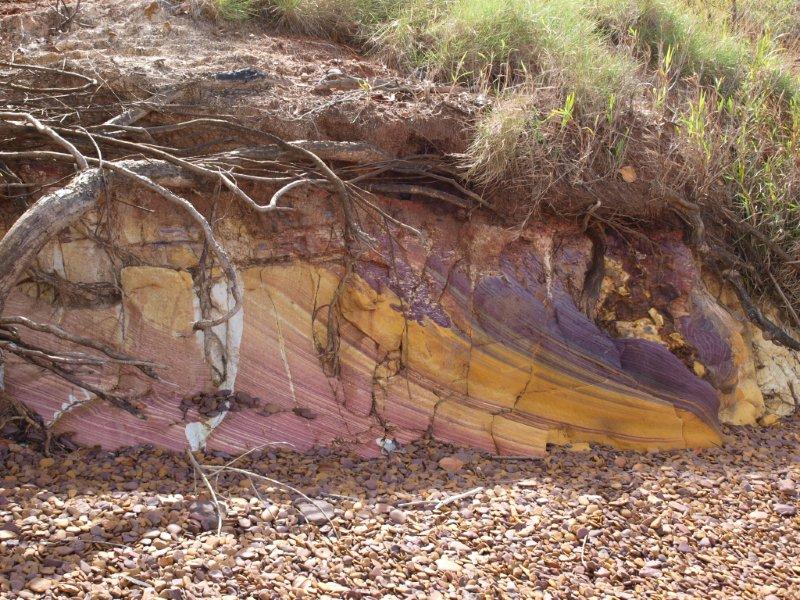
Run your hand along the cliffs and you discover that the vivid colours are clay that you can smudge and paint with. ‘Since I’ve seen this place I feel I understand the local art so much better,’ says Stewart and I understand what he means. The colour, the pattern, the rhythm of this place finds a distant echo in the art and sculpture of the island.

That night we eat fish, freshly caught by Stewart and Rin. It is sweet and utterly delicious. Before dinner I sit in the club and have a beer with three of the locals who are quietly enjoying one of their regulation six beers. They ask my name and welcome me with an easy camaraderie that feels utterly natural; making no concession to my foreignness they simply include me in their conversation as if I’ve always lived here and know the people and issues they speak of as intimately as they do. It's unforced, without pretension and very relaxing: no questions to be answered, no expectations to be met.

In the morning I visit Ranku’s tiny primary school. It has nine pupils aged between 5and 11, two preschoolers and two teachers. The kids are generous with their smiles and hugs. They ask me questions about London, sing a song for me, show me their paintings and give me two to take away. But some of them are facing pretty big issues. One nine year old boy's father committed suicide two years ago; two sisters, aged 9 and 11, are being looked after by extended family after their mother brought them over from Darwin and left again; a third boy has a broken arm and empty eyes. He's the only one who doesn't smile all morning. There's hope here but it's tempered by reality.

As I prepare to leave, the village is still in the rising heat of the morning. Two women walk from the store carrying bottles of bright orange soft drink and chatting softly together. They see me, smile wide and welcoming and greet me with a wave. I feel as if I’ve lived here for months and a genuine wrench at leaving.

The Intervention

Imagine an estate where unemployment is the norm, poverty, alcohol and drug addiction are rife. Child neglect and truancy are common and then a case of child abuse is discovered. The government acts.

Benefits are no longer paid in cash, instead a Basics card is issued that can only be used for groceries and other basic needs. Alcohol is banned (unless you have a permit, which is difficult to obtain). and residents are searched whenever they enter the estate. They are limited to visiting a pub between 4.30pm and 7.30pm, four days a week, when they are not permitted to drink more than six bottles of beer. Pornography is declared illegal. In order to implement these rules the Human Rights Act has to be suspended.

Sounds draconian. Sounds like the kind of thing a government would never get away with? Well they do in Australia; but only in the Northern Territory and only in indigenous communities.

The programme is called the intervention and I’m about to visit one of the communities affected: Bathurst Island, one of the Tiwi Islands in the far north of Australia.

Tuesday, 27 April 2010

Darwin...more culture in a yoghurt?

Darwin and I don't exactly hit it off. Maybe it’s the heat. It’s not just hot (35C at best) but also seriously humid.

The minute you step outside it’s as if an overly intimate and very clammy friend has grasped you in a damp and sweaty embrace and then, for good measure, climbed on your back for a piggy back ride. Every step you take you can feel him clinging hot and wetly to your back. Ten steps, 15 at most and you are dripping. Not perspiring gently, no girlish sheen, this is proper, unreconstructed dripping sweat.

I arrive on a Friday evening that marks the start of a bank holiday weekend and it seems as if the vast majority of locals have taken up binge drinking as a competitive sport. Over the whole weekend, pubs are bustling from 11am onwards. On Anzac Day (the Australian Remembrance Day) the whole city is awash with men in military uniforms or suits adorned with medals crowding into pubs and spilling onto the street. By 3pm there are people vomiting in the gutter, two men are scuffling and throwing punches as a police car draws up with a lazy flash of its lights and others are shouting and whistling at women as they pass by.

Those locals that aren’t constantly under the weather are plain eccentric. I’m sitting in a cafe, trying to cool off in the air conditioned interior, when a woman rides up on a penny farthing bicycle. She has a large stuffed penguin in a basket on the handlebars. She parks the bike, no mean feat in itself, picks up the penguin, finds a table for two and carefully seats the penguin opposite her. Then she orders breakfast and calmly eats it, before cycling off again, penguin in pride of place.

Monday morning dawns every bit as hot and sweaty as the last two days but I force myself to find the energy to visit the Museum and Art Gallery of the Northern Territory. It’s beautifully cool and eclectically diverting. There’s a huge stuffed crocodile called Sweetheart who terrorised local fishermen before dying in a bungled capture attempt in the late 70s. He is immense: 5.1metres long, with a 2.4m snout and, according to the laconic expert who explains the story, the only crocodile he’s ever seen with chipped teeth. ‘I think it must be because he used to bite the propellers off the boats,’ he says. That would probably do it, I think to myself, but in case you don't believe him he has a picture of a metal dinghy with two very large crocodile bite marks right through it.

In the gallery next door to Sweetheart is ReCoil a great exhibition of indigenous weaving with some really inspiring work ranging from colourful baskets to totems and more contemporary art style pieces. Coil weaving has become widespread in Aboriginal communities in the last 30years or so and as women travel they share their skills with others. Check out artist Nalda Searles who writes a couple of blogs on the subject.

When I emerge back into the heat at the end of my visit I find I’ve also reached the turquoise waters of the Timor Sea. Unfortunately you can’t dive in and cool off (if the deadly Box jellyfish don’t get you then the crocodiles will) but it is very beautiful. I wander along the beach and discover the Darwin Ski Club.

First I think it’s an ironic joke but it is in fact the water ski club, which turns out to be primarily a very laid back and very charming beachside bar where you can have a drink in the palm fringed gardens and admire the sea from a safe distance.

I hesitate for a fraction of a second then sit myself down and order a cold beer. If you can’t beat them, I think to myself as I drain it in no time at all and order another. And it seems the locals might be on to something for, as I leave the bar 90 minutes and three beers later, I seem to be finally warming to Darwin.

Saturday, 24 April 2010

Alice Springs to Darwin, 1420km, travelling time 24 hours

I'm writing this sitting in my Gold cabin on The Ghan (I was upgraded, hurrah!), sipping a cold beer, waiting for lunch to be called and wishing the journey would never end.

The cabin is amazing. There’s a double bed at one end, a fitted wardrobe and a table with two armchairs, one beside each window. At the other end, there’s a small fridge (filled with said beer and a bottle of champagne), hot water for tea or coffee, a TV and DVD player and a compact bathroom, complete with shower.

The decor is retro – oak panelled furniture, ornate engraved mirrors, brass fittings – but that just adds to the charm of it all. This is the kind of rail journey I always dreamed about taking but didn’t really think still existed: leisurely, sophisticated, romantic. All it needs now is someone to share it with and I think briefly of wandering down to the economy seats and inviting the young Italian boy with shiny dark curls and soft calf brown eyes that I chatted with while we were waiting to board to join me.

We left Alice Springs at 6pm last night. The sun was setting with typical outback drama, sky festooned with pink, orange and red. I dress for dinner (well put on some lipstick anyway) and wander down to the bar car. There’s a glass of champagne to welcome us aboard and the atmosphere is giddy and heady. Almost all of the other passengers are over 65 but that doesn’t stop the party jumping.

Then it’s time for dinner and I discover the glory that is the dining car: softly lit tables for four, linen table cloths, old fashioned silver and a delicious menu (king prawns and salmon starter, followed by rare steak and a cheeseboard for me). We’re seated by the stewards and I find myself next to Betty.

She’s nearly 80, travels widely and has been single for 22 years since her husband died. Is she, I ask delicately, perhaps particularly fussy in what she’s looking for in a man? Not at all, she says. ‘All I want is a man who can walk and talk.’ That does indeed seem very reasonable, I say, and surely not so hard to find. She snorts derisively. ‘You’d thinks so but the last bloke I was seeing could hardly walk and we’d go out for a meal and he wouldn’t say a word.’ Over a bottle of red we commiserate on the difficulty of finding a suitable man and the dark countryside outside clacks by mile after clickety mile.

After the champagne and red wine I’m all done in but no one will hear of bed. A nightcap, it seems, is the order of the day. We retire to the bar and I meet Val. She’s wearing a lime green three piece trouser suit and has tight chestnut curls. After a while, apropos of not very much at all, she stands up, declares her love for Shirley Bassey and treats us all to a very fine rendition of Hey Big Spender.

‘I don’t pop my cork for every man in town,’ she sings, moving up and down the carriage and shimmying in front of several startled male passengers who glance nervously at their wives. ‘Hey big spender, spend...a little time...with me.’ Right on the final note she ends up in her husband’s lap, to the cheers of the entire carriage. Her husband rolls his eyes at me. ‘Been doing it for 30 years,’ he says. ‘Party trick. Better with the music.’ And on that note I retire to my cabin, lie in my bed and watch the stars glide past my window as I drift off to sleep.

At 6am the steward, a gentle, welcoming and hospitable man called Anthony who is unfailingly pleasant, knocks on the door and brings me a cup of tea. I lie, sip and savour it as I watch the sun rise, then wander to the dining car for breakfast – fresh fruit followed by poached eggs, bacon, tomatoes and mushrooms, toast and jam and lots of coffee.

Outside the scenery has changed. Gone is the seeming emptiness of the red centre, in its place an almost tropical north. Trees, some with vivid orange bark, cluster densely side by side and an army of deep red termite mounds (many as tall as a man) stand sentry in long grass.

At 9am we break in Katherine, wander off to explore the gorge and then return to the train for a 1pm departure. And here I am now. It’s only 5 hours to Darwin but I’m seriously hoping there’s some kind of breakdown that means we need to spend a little bit longer on board.

Thursday, 22 April 2010

A town like Alice

Alice Springs hunkers low between the rust red hills of the MacDonnell Ranges and the sandy bottomed Todd River. At 8am the day is cool and clear, with pale blue skies and a gentle breeze but already the air carries a hint of the temperatures to come.

By late morning the heat is shimmering from the corrugated iron roofs and the bitumen streets feel molten beneath your feet. Shopkeepers retreat to dim air-conditioned interiors; shoppers emerge blinking and squinting and disappear rapidly into vehicles.

A small group of Aboriginals doze in the shade on the green grass beside the library. Aside from the slow caw caw caw of a lazy crow, the town is silent. When a squabble breaks out among the group in the park the noise clatters down the quiet streets. The disagreement escalates and eventually one man separates from the group and walks with a swinging gait down the empty mall, muttering and throwing the occasional insult back over his shoulders. Then silence descends again and the town dozes through its unofficial siesta.

This has been a great year for rain here. The city had 600mm of rain this wet season against an average of around 300mm. Last year it received just 75mm all year (England's north, by comparison, averages 1,500mm a year and can reach totals of 5000mm). The hills around the city are covered with grass but the river remains virtually dry. Occasional shallow waterholes, the water lukewarm around your ankles, are filled with darting fish.

By 4pm the worst of the heat is retreating. The silver river gums that line the sandy river bed cast cool dappled shade; the vivid red of the surrounding hills and the indigo blue of the sky soften to paler shades. On the river bed, in the shade on the cool sand, a small group of Aboriginals drink cans of beer around a fire, their voices floating softly across to the banks.

A young woman wearing a floral skirt pushes her two sons on swings in the park. The youngest, a chubby toddler of about two with caramel coloured skin and baby curling blond hair, throws back his head and laughs in delight as the swing flings him high. In a neighbouring front garden, a young man, shirtless, holds a tiny baby to his bare chest with one arm and pushes a lawn cutter lazily with the other. ‘Alright,’ he calls languidly in greeting. On the verandah of the pub, condensation gathers on ice cold beer glasses as people sit, legs on the railing, washing away the taste of another day’s work.

Once the sun sinks a rapid and surprising coolness blows through the town, taking the edge of the heat and emotions. It’s possible to walk a little faster and laugh a little louder and then sleep, the water cooled air conditioned air blowing softly across your back. Stars take over the sky, a mass of gentle light that offer no competition to the growing moon.