Monday, 31 May 2010

Beachside bliss

On Friday I lose my traveller cool. Not only do I have a raging case of PMT (never conducive to zen-like behaviour) but I also find out that I can’t take the train to my next destination: Mui Ne, a small resort on the coast some 300km north of HCMC. I have to climb back on the wretched bus, which then takes seven hours for a four hour journey.

We have a driver so laid back the bus doesn’t hit above 50km an hour for the entire seven hours and the traffic coming out of HCMC makes the M25 look like a peaceful country lane. We sit and splutter and stutter for minute after minute, hour after hour, and my mood goes from bored to impatient to frustrated to raging.

Finally we arrive. I have a list of requirements: beach side bungalow, air conditioned, no more than $15, must have wifi, preferably a garden and a pool. An older gentleman on a scooter says he knows just the place. I vow not to like it as I break my earlier vow and jump on the back (the traffic here is non-existent).

But in fact he delivers me to the perfect spot. I take one look at the room and begin to relax. I’m in my bikini within five minutes and in the sea within six. A few minutes later and I’m the master of zen again.

Frankly who wouldn’t be? Mui Ne is a sweep of beach some 10 miles long. Low rise bungalows (ranging from budget to swish) stretch along the shore, hidden by palm trees and gardens. There are beachside bars and restaurants and, thanks to daily on shore breezes, a whole community of buff kite surfers who’ve taken up residence. There’s one peaceful road running the length of the resort with more bars and restaurants stretched along it.

A local community of fishermen still use the beach and you can see their round boats bobbing around in the sea day and night. It’s the low season and it seems to me to be the perfect time to visit – enough people about to have a bit of a vibe but plenty of rooms and virtually no one on the beach.

I plan to stay for two days but end up staying four. I swim in the sea before eating breakfast at a beachside cafe. Then I lie under the shade of a palm tree, reading and dipping into the sea whenever I get too hot. The water is refreshing but warm enough that you can float in it till your fingers and toes are white and totally wrinkled. That’s pretty much my day, with the odd break for a little more eating and drinking.

I meet a fruit seller on the beach who tempts me with fresh pineapple and lychees. It’s 35C and though there’s a cool breeze the sun is beating down. She doesn’t seem to mind. She’s wearing two hats (a large cloth one covered by the traditional Vietnamese conical design), a face mask, two long sleeved blouses covered by a jumper and a coat (she proudly counts the layers out for me ‘one, two, three, four), trousers and flip flops with socks. ‘The sun is too hot for skin,’ she tells me; staying pale is preferable to staying cool.

One night I hook up with Lucy, an Irish engineer, and her Aussie boyfriend Todd. We drink beer by the beach (Todd setting a fearsome pace) and then wander along the strip drinking beers in any bar we fancy. We fuel up at La Luna, an Italian restaurant that delivers deliciously authentic wood-fired pizzas and then catch a cab to Samarra, a five star beachside club complete with tented white spaces in which to recline and a shimmering light show. We drink watermelon martinis and dance on the sand before walking home back along the beach.

Mui Ne feels like a tropical Ibiza at about a tenth of the price but if you fancy a visit come soon. The Russians have already discovered the resort (thanks to long links with communist Vietnam) and there are already plenty of upmarket restaurants and clubs (including a black and white vodka and sushi bar called Snow). The laid back surfer vibe might not be here for much longer.

Wednesday, 26 May 2010

How to cross the road in Ho Chi Minh City

Vietnam feels much more prosperous than Cambodia. On the Cambodian side of the border we stutter along a narrow two lane road with dusty verges and fragile skeletal bamboo framed homes right up on the roadside. In Vietnam, we're immediately on a four lane highway, with special scooter only lanes, landscaped central islands and pavements for pedestrians.

The houses are sturdy and painted; the general air of neglect and decay that typifies Cambodia (and lends it some of its laid back charm) is gone. As we enter Saigon (the central distric of HCMC) advertising hoardings, European brands, glass fronted shops and high rise blocks come into view.

There are hardly any bicycles in evidence either. Tuk tuks are replaced by taxis, buses and cars. In Cambodia, outside Pnomh Penh, cars are still relatively rare. They are so valuable that I once saw one parked inside a living room with six broad based wooden armchairs set on the edges of the room around it.

But after the tranquility of Cambodia, where even Pnomh Penh has a faintly rural feel, the traffic in HCMC is startling. Along with the volumne comes a disregard for rules of the road. Some people drive the wrong way because it's easier or more convenient, others use the pavement as a turning cirlce or shortcut.

What's even more startling is that you're expected to brave the chaos and cross the road. There's no point waiting for a gap in the traffic (there never is any) or a green walk signal (they are utterly ignored). You simply need to take your life in your hands, step out and walk.

The secret, believe it or not, is to walk very very very slowly. One tiny footstep in front of the other. This allows car drivers and scooters to estimate your position and take evasive action. They don't slow down much but they do drive round you.

The first two times I try it, I cross in the slipstream of locals, first a young student and then an elderly woman wearing (to my delight) the traditional conical hat. Neither deign to make eye contact with the traffic. They simply keep their eye on their destination and walk, very slowly but deliberately, into the road. At first I watch the cars and the bikes buzz by, but by the end of the day I too am staying zen-like and focused on my target. If nothing else, it's better for my heart rate.

Then I make the mistake of taking a moto home. It's been a long hot day and I don't fancy the walk. But 10 seconds into the longest 5 minute ride of my life, I'm utterly terrified. We whizz along, dodging and weaving. At one point the driver turns to chat to me. 'There are more than 4million scooters in HCMC,' he says proudly.

No kidding, I think, I can see about 3million of them right here, right now, driving straight at us. When I get off my legs are shaking and I'm perspiring with fear. The driver notices my hand shake as I take out the money to pay him.

He touches my arm and smiles. 'You get used,' he says. 'Not long, you get used.'

Not in this lifetime, I think and I swear to myself that I have taken my last motorbike ride between here and Berlin.

And here's a picture for those of you who work in health and safety or maybe municipal electrics. HCMC blows your mind (very possibly literally) with its wiring scheme!

Monday, 24 May 2010

Goodbye Cambodia

My last day in Cambodia and the country turns on the heat for me as the thermometer reaches 45C in Pnomh Penh. Combined with sweltering humidity I feel a bit like a roast dinner in a steam oven, cooking slowly and wetly.

In a bid to beat the heat, days start early here. From 5.30am the cafes are pulling up their shutters. Moto drivers stretch and scratch by their vehicles and sleepy eyed women are laying out their wares in the market: shiny green limes, pale pink lychees, the vibrant cerise of dragon fruit, the yellow green bananas and olden pineapples.

By 7am the day is in full swing. The cafes are filled with men, eating soup or drinking sweet coffee, their backs to the road watching the TV that is inevitably blaring away in a corner. Monks, one behind the other like a string of saffron, are walking the roads for breakfast and alms, offering sing song prayers of thanks and good health to those that oblige.

The children on the morning shift at school are pressed clean in white and navy, walking or cycling to class. In the market the women are chopping the heads of the fish and swatting away the flies, calling to each other, laughing and bartering. Street vendors with long bamboo canes balanced over their shoulders, finely balanced on each side, are walking and shouting up their business in the busy streets.

By mid morning the heat is cranking up the volume. In the dusty northern fields, wiry farmers follow scrawny oxen behind the plough, dust rising in eddies behind them. Chickens, long legged and delicate, scratch in the dirt and a cockerel gives a half hearted crow. In the river, men and women walk along behind fishing nets, shoulder deep in yellow water that is as tepid as a bath.

Scooters packed with people and goods buzz along the streets; one has the bodies of four pigs strapped sideways alongside the driver, their trotters bouncing forlornly as the bike bumps along the road. Four policemen squeeze on one bike; a young family, three children and their parents squashed close together, pass by and wave and smile.

At lunchtime the heat is unmanageable. Even the moto drivers have given up their tout for business and are parked under trees and lying across the back of the tuk tuk searching for sleep. The never ending traffic slows and stutters. Skeletal Brahmin cows, their skin the colour and texture of pebbles washed white by the sea seek whatever shade they can find.

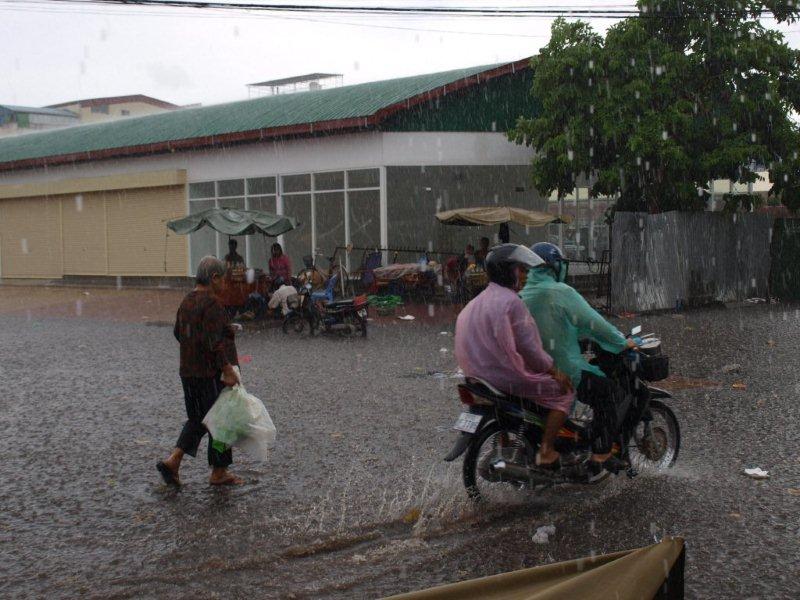
A small breeze picks up and by mid afternoon the clouds are gathering, bruised blue black in the sky. A sharp breeze rises, dust spins into my eyes and sticks to my sweaty arms. My t-shirt is ringed with damp and dirt. One fat drop announces the rain storm the city has been waiting for and soon we’re engulfed in a deluge.

The streets become rivers; young children swim and splash and narrowly miss the wheels of scooters that splash by. Two young boys dance on a roof, hands in the air with joy. Almost as soon as it’s begun, it’s over again. The air has cooled a little but the humidity rises.

Finally the sun heads towards the horizon and the temperature becomes bearable. Workers start their commute home. The city is filled with the horns of a thousand scooters, bikes and the occasional shiny NGO-owned Lexus. Pedestrians and vehicles cross and turn and swoop and glide like partners in a chaotic but choreographed dance.

Along the river front, courting teenagers cruise up and down in the sunset light, the girls sitting side saddle on the scooters. In a park a group of shirtless men, shiny sweat sheened brown, play volleyball. Shopkeepers swing in hammocks, farmers rest on raised platforms and chat, a young mother washes a plump baby in a wide lipped earthenware jug.

The bars open and young girls in high heels perch on the arms of chairs. Beside them, old white men with the gleam of sweat on their pink heads, drink beer and pontificate. The restaurants and cafes fill. Men drink pitchers of beer and eat rice and noodles and wave their chopsticks around as they talk. Women sip ice coffee and tea and look cool in their silk or cotton pyjama suits.

By 10.30pm most are in bed; the heat is almost bearable. I lie spread eagled on my bed, under the fan, dreaming of winter.

The young ones...

Today I saw an old woman. Toothless, with wispy hair and a thousand wrinkles she leant on the arm of a younger man and walked slowly along the road. And it came to me suddenly how few old people there are in this country.

Everywhere you look you see children, teenagers and those in their 20s. According to statistics, 50% of the population is under 18. Looking around it feels as if another 45% are under 30.

Given Cambodia’s violent recent history it should come as no surprise. On April 17, 1975, the Khmer Rouge, an extreme Maoist/Marxist group, took control of the country. It wanted to turn Cambodia into a giant peasant based agrarian cooperative and emptied Pnomh Penh of people, forcing families to march from the city to the countryside. The entire population of the country, men, women and children, was forced to work, often up to 18 hours a day in the fields. Many starved to death, many more were tortured and executed.

During the 3 years, 8 months and 20 days of the Khmer Rouge rule, somewhere between 1.5 and 3million Cambodians were murdered or died (historians still struggle for an accurate count). This amounts to almost a quarter of the population. You can find out more here or here.

After the Khmer Rouge were disposed by the Vietnamese in 1979, they kept up a guerrilla war that didn’t end until 1991 and their last strongholds were not routed until 1998.

Looking around Cambodia today it feels as if two generations of people are missing. Not only the older generations who died in the 70s but also the generation of 25-35 year olds, who just weren’t conceived during those years of war and terror.

I visit the Tuol Sleng Museum in Pnomh Penh to find out a bit more. Formerly a suburban high school, the Khmer Rouge turned it into a security prison called S21. Classrooms became tiny prison cells and torture chambers. Of the almost 17,000 adults who were incarcerated here, only seven survived. Children were killed too. Those who survived the torture were bludgeoned to death to save bullets.

It’s a terribly distressing place, even today. The cells and torture chambers remain intact and in other rooms the pictures of those who were imprisoned here – the Khmer Rouge kept meticulous records – are on show. Men and women, girls and boys. Some look terrified, others bemused.

When I come out, the moto driver notices my mood. He’s 45, a few years older than me, with a worn face, only a small selection of his original teeth and the gentle smile that’s so common in this country. He looks 55, maybe more.

‘It’s a sad place,’ he says.

I nod.

‘My father, my brother and my uncle. They all died during that time,’ he says. Then with a little grimace of his mouth and a barely there shrug, he turns and kick starts the bike.

Sunday, 23 May 2010

Food, glorious food


Cambodian food is, as you’d expect, a cross between the chilli and lemon grass flavours of Thai cookery and the oyster sauce stir fries and herb filled spring rolls of Vietnam.

My favourites are the eye wateringly hot soups, clear broths for the most part, usually fish based and filled with lemongrass, lime, chilli and garlic. I also like the herby fresh spring rolls – mint, basil and coriander mixed with bean sprouts, prawns and rice noodles and dipped in a garlic, chilli and fish sauce dip. Yum, yum and yum again.

Yesterday I had the chance to take a day’s cookery course with Siolahn, a local woman who teaches westerners Cambodian cookery. She’s in her 30s, plump and round with dimples in her upper arms and sturdy short legs. Entirely capable, she can chop, pummel, twist and style an entire dish in the time it takes me to tidy the corner of my first spring roll.

Siolahn watches our attempts with much the same look that you have when you watch children learn something. Every now and then she can’t help herself and pops round to fix and improve our sorry efforts. You can see that she makes these simple dishes every day and still can’t comprehend that we struggle to cook them and, even more incomprehensibly, that we offer to pay her for her help.

She tells me she comes from a farming district in the country’s east. Until three years ago she worked in the fields and looked after her family. ‘We didn’t see any tourists there and it is a very hard life, very hard to earn money,’ she says. ‘My friends told me that there were a lot of Westerners in Sihanoukville and good jobs with good money, so my husband and I moved down here.’

And for once it seems the stories of a city paved with gold have turned out to be true. When I ask her if she likes it here a huge smile spreads over her face. ‘I will never go back. There are so many tourists here.’

It was a fun day and at least in theory, when I get home I’ll now be able to host a Cambodian dinner party. The menu? Seafood soup followed by summer spring rolls, then Lok Lak, a peppery beef stir fry served with rice and a fried egg for main and sticky coconut rice with mango for dessert.

For those who’d rather make something themselves than wait for a dinner invite from me, here’s the recipe for the seafood soup. It takes about 15 minutes to make from start to finish and is a great way to blow the cobwebs away with a hit of chilli, garlic and lemongrass.

Seafood soup with lime and fresh herbs (serves 4)
Ingredients:
-White fish – any type but ideally one that doesn’t break up too easily, 400grams, cut into 4 pieces
-Squid and prawns (at least a couple of pieces of each per person)
-Fish stock (about 1 litre, make up as you prefer)
-1 small tablespoon rice
-2 stalks lemon grass, crushed
-Thumb size piece of Galangal, peeled and crushed
-2 kaffir lime leaves
-4 cloves of garlic, finely chopped
-1 ½ teaspoons salt
-Basil (a small handful, torn)
-Saw mint (8 long leaves) – if not available use coriander, a small handful
-Spring onion or two cut finely
-2 red chilli (reduce if you prefer less heat) finely chopped, including seeds
-Juice of two limes
-2 limes, quartered, for serving

Method:
-Add the tablespoon of rice to the stock and bring stock to boil.
-When boiling add crushed lemongrass, garlic, galangal, lime leaves (torn) and salt.
-Simmer for five to 10 minutes.
-Add fish. Cover pan, reduce heat and simmer for 5 minutes (fish should be cooked).
-Add seafood and simmer for 2 minutes (or until cooked).
-Divide torn herbs (basil and saw mint), spring onion and chilli between 4 bowls
-Ladle soup (including lemon grass etc) over the herbs, season generously with lime juice and serve with half a lime (add to taste). Cambodians don’t eat the lemongrass or galangal but it’s perfectly acceptable to chew and suck on them for taste and then leave them in the bowl.
Note: if you’re making this for fewer people you can halve the ingredients for two servings but not quarter for one as you’ll lose taste. My advice: make two servings and eat it the next day!

Thursday, 20 May 2010

Trouble in paradise

I wake to find the mosquito net billowing about me. I raise my head and see Hannah kneeling at the foot of the bed.

‘What are you doing? Why are you messing with the net?’ I’m half asleep still.

‘It’s not me, can’t you feel the wind?’ she sounds a bit harried.

It’s the middle of the night and I’m not in the mood to wake so I lie back down again, but a sudden crack of thunder over head forces me to open my eyes just as a sheet of lighting brightens the room to virtual daylight. Dazed I sit up.

There’s lighting on every side, huge bright sheets that seem very close. Claps of thunder follow the lighting with impressive speed and the wind whips up and up, faster and faster until it’s roaring around our ears and the net is whipping into our faces. The hissing sound of rain on the roof announces that the storm is well and truly here.

I’m fully awake now. We’re in the centre of a massive tropical storm and we’re sleeping in a tree house, some 10metres off the ground (the perfect lighting rod, I think to myself) and open on three sides to the elements.

It seemed idyllic when we arrived this morning. On a secluded bay on the island of Koh Rong, some 2hours by boat from Sihanoukville, we’re the only guests at this virtually new guest house; the owners, local girl Nuch Ros and her Turkish husband Bora Ozturk, are still building the restaurant and other bungalows.

We are also the only passengers on the boat overnighting here and when we step off onto the rickety pier by the tiny fishing village that calls this bay its home, we walk along a mile long curve of white sand bordered by turquoise blue sea to get to the cottages. The sky is a deeper shade of blue and the island itself a tropical green.

At the end of the beach we turn off into the undergrowth, following a faded path for another 100 metres and find ourselves on a smaller bay and at the foot of the tree house. There are 10 steps to the shower, which also has beautiful views of the seat, and another 12 to the bedroom. It is utterly peaceful; all we can hear is the soft rush of the sea as it runs in to greet the sand.

We spend the day swimming in the sea, lying on the shade in the sand and resting in the tree house. With sea views on three sides and high enough to catch the breeze it’s a blissful spot to lounge.

Nuch and Bora invite us to join them and their friend Srey Ra for dinner and we sit on the raised platform that serves as their kitchen, ducks, chickens and geese scratching around below, and eat fried rice, hot chips (cooked especially for our western palate) and the most delicious aubergine and beef dish. Thick as paste it is smoky, spicy and very moreish.

At 9pm the generator is switched off so we have an early night. The heat is astounding, 38C perhaps. There’s not a breath of breeze and the hot air sits on us like a heavy blanket. In the far distance the night sky offers a light show as lighting flashes across, sometimes in huge sheets, other times forks that connect the clouds and very occasionally a bolt that strikes the sea like a trident thrown by an angry god.

But now, some two hours later, the temperature has dropped, is dropping by the minute and the room feels almost chill. Our towels and bikinis, which were drying on the rail outside are billowing. I make a dash for it, lighting illuminating the way and rescue what I can. My bikini top and a towel have already blown into the night sky. The rain is pelting down and in through the windows. I'm wet and the edge of the bed is already damp.

We sit and watch the storm attack from three sides, thunder clapping directly overhead, lightening with a photo flash brillians. It feels as if we’re sitting in the clouds themselves. The trees around us sway and bend and thrash. The house creaks and it dawns on us that the tree house is new, it hasn’t yet survived a wet season.

‘Do you think it will be alright?’
‘Should we climb down?’

We giggle a little hysterically but sit tight. The house is sturdy and the storm is just a storm not a typhoon or cyclone. But up high, exposed, it feels first exciting, then nerve wracking and eventually tiring. When the wind finally lets up, an hour or more later, we crash into a relieved sleep and in the morning the island is as beautiful as ever.

The sea is crystal clear, the sky blue. We retrieve my bikini from the bushes nearby and spot the towel, high in a neighbouring tree then go for an early morning swim. We are the only people on the beach, virtually the only visitors on the island. It is a magical and peaceful paradise.

Later Nuch tells us that the island has been bought by an Australian consortium. There are plans for an airport and a large resort but these have been put on hold because of the global financial crisis. It seems churlish but I sincerely hope they never get it off the ground.

Monday, 17 May 2010

Bamboo train

Travelling by train in Cambodia was popular during French colonial times but both track and rolling stock were destroyed during the Khmer Rouge era and the war that followed. As you travel through the country you see abandoned train lines crossing roads and fields, weeds and trees growing among the sleepers.

But just outside Battanbang in the country’s north west, it’s possible to travel 135km through fields and rice paddies on the bamboo train. Making use of a section of rail that remains in relatively good repair, bamboo trains are ingenious little contraptions that move people, produce and even livestock. Hannah and I hire a tuk tuk and motor out to give it a try over 15km or so.

Each ‘train’ is nothing more than a bamboo frame of about 3m long by 2m wide. The frame sits on two detachable axles and is driven by a small motor. Around 30 people share ownership of the frame, each person taking control for one day of the month and making a living based on the number of rides they can generate on their day.

We find a spare train, sit ourselves on its bamboo frame and get started – it’s a bone shakingly uncomfortable ride that feels like a fairground attraction as it hurtles down the hill, rattles over a bridge and tilts precipitously round a corner. I lean in to avoid branches whipping by. Beside us are the arid rice paddies of the dry season.

We rattle on for half an hour or so until ahead of us another train carrying 10 locals slows at a stop and we pull in behind. A third train carrying a vast load of wood is coming the other way and by the rules of the line both passenger vehicles need to give way. When two trains meet, the lightest must dismantle – removing the bamboo tray and lifting the axles and wheels to the side – to let the heavier pass.

For our train this is simple, carrying just the two of us and our little bags it takes less than a minute, but the train in front is loaded up with bags, baskets, people and even a motorbike. After ten minutes or so it’s fully dismantled. The train carrying the wood moves slowly past and behind it the other train is being rebuilt, with chat and general good will all round.

This unique method of transport is on its last legs. Late last year a project began to link Pnomh Penh to both Bangkok and Ho Chi Minh City by rail. Slow progress is being made and once it reaches Battambang the bamboo train will be no more.