Tuesday, 27 July 2010

Trans Mongolian: Beijing to Ulaan Batar, 30 hours, 1,500km

The train pulls out of Beijing’s central station precisely at 7.47am. Some of China’s train stations maybe chaotic and crowded but Beijing Central is anything but. Wide clean corridors with sleek polished floors, chandeliers and comfortable chairs are the order of the day here.

The train itself, in contrast, is an old one, painted green and gold and with hard bunks and a rattling fan in place of air conditioning.

It takes almost an hour before we leave the outskirts of Beijing behind and perhaps another hour before the smog disappears and the sky becomes visible again. Soon the engine is straining up mountain sides and through long tunnels, offering glimpses of high cliffs of rock on one side and mountains and rural villages on the other.

By lunchtime we’re in the coal belt of northern China and by mid afternoon in the province of Inner Mongolia. Arid grasslands bleed into dusty hills that fill the horizon. Occasionally I glimpse sections of the Great Wall; sometimes crumbling, sometimes standing firm, winding its way along hillsides and through valleys. The train is peaceful. I'm sharing my compartment with two German travellers, Sonja and Marcus. In the compartment next door, two Mongolian men sing lustily, presumably happy to be heading home.

As afternoon gives way to evening I wander to the dining car with Sonja and Marcus. We drink cold beer and eat tomatoes and eggs, roast chicken and rice and spicy pork with green peppers and watch the Gobi desert begin to slide by outside the window. Whirls of dust follow the train along the empty, almost desolate countryside.

At 8pm we reach the Chinese border. A fierce looking customs official appears at the door asking for passports. I hand him mine and say ‘thank you’ in Chinese. His officious face dissolves in a huge smile and he transforms from a fearsome official to a shy teenager in seconds.

I join the crowd of passengers on the platform where we wait for two hours for immigration to be completed and for the train to be changed to the Mongolian and Russian gauge base. (Mongolia and Russia have slightly different rail sizes to most of the rest of the world). With great clanking and juddering, huge jacks lift the carriages from one base to the other.

Eventually the whistle sounds and we board and I lie, sleepy, on my bunk. I hear music as the train starts to move and, curious, walk to the open window to see what’s happening. The music is the Chinese national anthem being piped through speakers at the station. As the train draws out, all the customs officials and railway staff stand to attention along the platform to see us off. I spot my customs official and smile at him. Once again he breaks ranks and returns the smile.

I find the ceremony surprisingly moving. Yes it’s nationalistic and yes China is a country that has serious issues with human rights. But at a one to one level, Chinese people are friendly, helpful, hospitable and patriotic. I’ve loved every day I’ve spent in the country and as I watch the platform disappear I realise I’m really going to miss it, too.

Half an hour later we cross the Mongolian border. The train pulls to a stop, customs officials board and we wait, this time in our cabins, for another two hours. There’s no power and the cabins are soon stiflingly hot. I fall asleep, only waking as we begin to move again to find my passport has materialised on the table beside me.

When I wake in the morning we’re leaving the Gobi behind us and entering the flat, featureless grasslands. An occasional white domed ger (the large tents in which nomadic Mongolians live)sits in the distance. A herd of camels graze on the sparse grasses alongside a smaller herd of horses. There are no roads, no towns, no houses, nothing. Until finally, at 4pm, we arrive in Ulaan Batar.

Monday, 26 July 2010

Beijing and the Great Wall

I stand on the small hill top looking out over the Forbidden City. I’ve climbed here for the views, which are said to be spectacular. In fact, I don’t see anything. A haze of smog and pollution hangs over the entire city. I can see the entrance to the Forbidden City some 50m below me, but further than that everything disappears behind the mist. My eyes are stinging and my nose is running. There’s a tickle in my throat and I can taste the lead of a million car exhausts on my tongue. Beijing’s air pollution is all it’s cracked up to be and worse.

I’ve been in the city for six days and, air quality aside, I really like it. It is a low level city with plenty of green, tree lined avenues. It has a city vibe but not the frenetic pace that defines Shanghai or London. People take time out to breathe. The residential neighbourhoods – or hutongs as the small alleyways are called – are charming. In the evening, neighbours sit outside their homes playing cards or badminton or chatting, kids ride their bikes and skateboards and it feels homely and welcoming.

I’m staying in a hostel that’s in the middle of a residential hutong. It has a small courtyard garden with red Chinese lanterns hanging from the beams and a softly trickling water feature. A fat smiling Buddha welcomes you at the entrance.

At the end of the street is a small park. A row of 12 table tennis tables lines the back fence, exercise equipment fills another corner and tables for mahjong and chess are set under trees. Anytime of the day and right into the deep dusk of evening you find men and women of all ages here, doing their exercises, competing vigorously for ping pong points or watching a game of chess, three deep around the tables.

Small restaurants dot the hutong. One night I eat fresh dumplings filled with pork and mushrooms, another night I savour a dish of spicy chicken with peanuts and chilli.

I arrive in Beijing on a Tuesday morning at rush hour. The roads are busy but no busier than a London rush hour; the bus is crowded but no more than a London bus at the same time. It takes me a few days to realise that the traffic and the crowded bus aren’t a function of the time of day. Whether you’re travelling at 8am on a Tuesday or 8am on Sunday or 8pm on a Saturday, the roads, the buses, the sidewalks are heaving with people.

Tourist attractions are unbelievably busy. Most visitors here are Chinese tourists and they find the foreigners they see as exotic as the city itself. I’m walking down the hutong one night. A man beside me is driving a small flock of geese along but the tourists who are walking towards us train their camera at me, trying to surreptitiously take their shot. At the Forbidden City people are always edging themselves beside me and when I look up I find I’m the subject of another photograph, sometimes with a smiling Chinese person standing beside me in the frame.

After a few days the sheer volume of people becomes exhausting. The Ming Dynasty Forbidden City becomes a crushing, seething mass of humanity that needs to be manoeuvred; the vast spaces of Tianamen Square (think London’s Trafalgar Square multiplied by 10 or Melbourne’s Federation Square multiplied by 50) resemble a paving stone where lines of ants are jostling and bumping and just about finding their way from one side to the other.

I take a breather from the city and take a day trip to the Great Wall. We drive for 3 hours to Simatai, a section of the wall that’s relatively unrestored and with few tourists. We hike up and there it is, a dragon’s tail of bricks and towers running over the hills and mountain tops in both directions. It’s surprisingly steep as it climbs up the edge of the hillside and down again.

We walk for three hours and I keep having to pinch myself at the reality of what I’m doing. ‘I’m walking the great wall of China,’ I tell myself and when the reality sinks in again it makes me laugh out loud with the improbability and pleasure of it.

Sunday, 25 July 2010

Panda bears and teracotta warriors

This isn’t so much a blog post as an excuse to post some cute pictures of panda bears. Yes, I’ve been visiting the panda sanctuary in Chengdu and have fallen for these big lazy puddings.

Pandas spend their lives either eating bamboo or sleeping and manage to cultivate a look that says ‘I’m seriously laid back’. They always find themselves a comfy spot and something to recline against seems to be an absolutely necessity. As they chew they occasionally reach lazily behind them for the next piece of bamboo. It reminds me of a person lying on a sofa reaching out for a handful of crisps while watching the telly.

They're so laid back they can hardly be bothered to mate and because they’re dependant on one food source they’re also very vulnerable when that food source becomes scarce for any reason. As a result, they’re an endangered species with only around 1500 remaining in the wild.

The centre here is home to some 80 bears; it’s basically a one species zoo that has been very successful in breeding panda bears in captivity. Conservationists would like to see more effort made at improving habitats and growing wild populations and China is now starting to trial a reintroduction programme too; so far unsuccessfully.

Other than Pandas, Chengdu is another big Chinese city – lots of traffic, lots of people – and after three days in the city I head off to my next destination, Xi’an; home to the Terracotta Warriors and a 20 hour train ride from Chengdu.

Xi’an is all concrete and high rise glass towers. I avoid the shopping malls and instead wander around the back streets, where I find a small market. Everywhere around me are men carrying small bamboo cages; they look like bird cages but are only a little bigger than a matchbox. They gather around an old man with a bicycle that seems to be singing and buzzing. I go closer. From every possible spot – the handlebars, the bar between the two wheels, the back carrier – hangs an impossibly balanced series of cages. The bike is piled 2m high or more with these tiny cages. The buzzing and humming is loud and insistent. I peer into the cages and find they are each home to an individual cricket. Around me men are bargaining hard, buying crickets and transferring them to their own cages. I ask why. They smile widely and mime a boxing fight. The crickets are apparently great fighters and these will be put to the test at local cricket fighting bouts. It’s a fight to the death and only one can be the champion.

Alongside the buzzing crickets, the highlight of my visit to Xi’an is the terracotta warrior museum. The effort that went into building this vast mausoleum is astounding.

Thousands upon thousands of soldiers stand in regimented lines in a huge pit bigger than two football pitches. Each one is unique: unique face, unique stature (some are thin, others sport a beer belly) and each has unique details right down to their hairstyle and the tread on their shoes. So far three separate pits have been excavated; more are still being found.

All of this is part of the mausoleum of Emperor Qinshihuang; credited with unifying China in 200BC and infamous for his bad-ass ways (which apparently included burying the artisans that made the warriors alive so that their secrets couldn’t be revealed). The Emperor’s actual tomb has yet to be excavated. Archaeologists suspect that it is surrounded by a river of mercury (along with a very large cache of precious stones and gold) and they’re still working out a way to safely access it. Where is Indiana Jones when you need him?

Thursday, 22 July 2010

Day 4: a burial and a wedding

The morning dawns clear and sharp. The pills seem to have worked. My headache is nothing but a dull pulse and I can face food again. But at this height, 4100m, the air feels thin and the sunlight has a sharpness to it, even at 7am. I’m glad I’m feeling better because we’ve been invited to witness a local sky burial, which takes place on one of the mountains that stand sentinel around the town.

A driver collects us and drives us to the site, a grassy slope with views across the valley to the mountains to the west. A few local men are already gathered around a fire, brewing tea and chatting. They smile at us, welcome us with 'tashi deleg' (the Tibetan catch all meaning hello, good morning, nice to see you) then sit companionably beside us. All around the views are breathtaking.

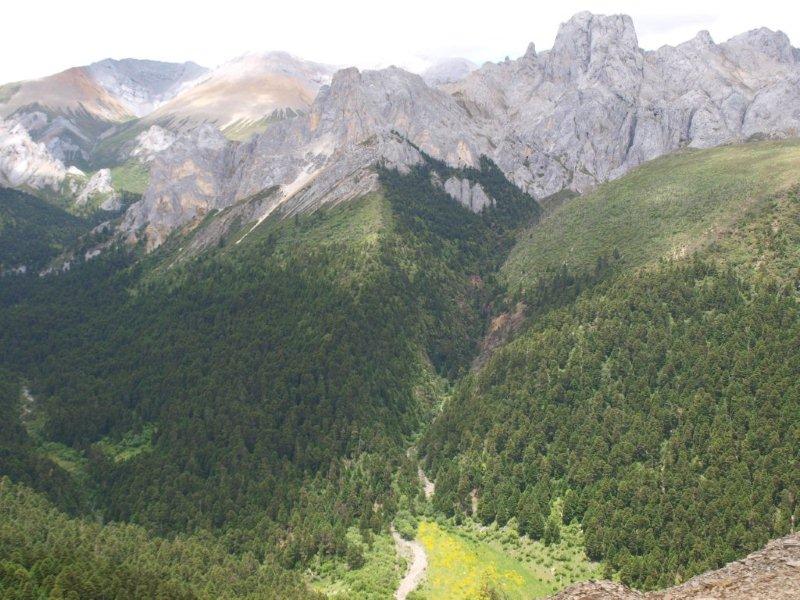
The grassy, flower covered slope we’re sitting on slides gently downwards for 50 metres or so, then rises on the other side for another 100 metres. Across the valley that spreads out far below us are more mountain peaks and directly behind us are high mountains and craggy stone cliffs. Up high we spot a flock of vultures, sitting still as stone, barely distinguishable from the rocks they’re perched on.

On the slope opposite us, some 100 metres or more away, lies the body, wrapped in white cloth. Four or five men squat beside it, waiting. After 10 minutes or so a monk, also dressed in white rather than the traditional maroon, approaches the body. The burial is about to begin and the men we are sitting with turn to watch the proceedings.

The monk unwraps the body and removes the clothes. From our distance it’s possible only to see the basic shape – arms, legs, torso – of the person. Then the men assisting the monk gather close around the body and we lose sight of what happens next. But, above us on the mountain top, the vultures take flight and float slowly down, their vast wings open wide to catch the warm currents. They look magnificent, regal even. It’s only when they land and, with their typical ungainly hop, approach the group around the body that they suddenly appear vulture-like again. In total 20 or more birds land on the hillside opposite and approach the group around the body.

The men move back in a wide circle to keep the birds at bay and we can see what it is that’s attracted them. The monk has started to dismember the body. From our distance we can’t see the details just that his small saw is moving over the body.

After about 15 minutes of sawing, at a signal from the monk the men move back and the birds descend. The body is obscured by a flock of birds, squawking and fighting for position. Wings flap and birds waddle in and out of the fray.

It feels unreal to be watching this. Some part of my mind knows this is a burial, a human body; another relegates the spectacle to nothing more than a performance. Writing now, the description sounds shocking and macabre, but actually the whole ceremony is remarkably tranquil. The men sitting with us are calm and more relaxed than people are at Western funerals, and the soothing sound of their voices and the beauty of the surroundings takes away from the violence before us.

Another five or 10 minutes pass then the burial party move in and scare the birds away. One bird drags meat with him; an attendant chases him off and brings the remains back to the body.

This time the monk has a small axe. He gathers together what remains of the body and begins to chop. He chops for the best part of an hour; it’s important that everything is crushed and that no distinguishably human elements remain. I watch the axe rise and fall and can hear a soft chunk as it makes contact. It has a mesmerising and, from this distance at least, almost meditative effect. Once again an aura of disbelief descends on my mind.

Up on our side of the hill, the fire is restarted. Food is brought out, tea is brewed and bottles of Coca Cola and Sprite are passed round. We squat in a circle around the fire and eat flat unleavened bread and dip our chopsticks into a communal dish of potatoes and peanuts. We chat about where we come from and ask about their families. A few of the men joke around; it feels as if they are letting off steam, as if a hidden tension within them is being dispersed.

After about an hour the sound of chanting drifts across the valley. Most of the men stand and wander over to the burial party on the other side; a couple stay to keep us company. A saffron cloaked monk has arrived to bless the final element of the funeral. He sits and chants and the friends of the deceased (relatives do not usually attend this element of the funeral) sit in a semi circle around him. Behind the monk, as respectful as a church full of worshippers, perch the vultures, in a semi circle of their own. For the next 10 minutes or so the birds ignore the other monk (who is still chopping away) and it seems as if they too pay their respects to the deceased.

When the ceremony is over the funeral party again gather in a circle around the white robed monk. He mixes barley in with the remains. The birds return. The funeral party steps further away from the body and then breaks the circle, allowing the birds their final feast.

It may seem like a grisly ritual but sky burials make sense in a mountain environment. Trees don’t grow at this height so there is little in the way of natural fuel for cremation and, particularly in winter when temperatures dip to -20c, burials in the ice covered land become impossible.

Still, as we leave the burial every detail around me – the colour of the sky, the small white clouds, the wind whispering in the grass and the bright wild flowers – seems heightened and in technicolour.

Our driver drops us back in town. There’s a wedding going on, he tells us, and it seems we (along with the rest of the population) are invited. When we arrive the bride and groom stand in front of a monk who is blessing them with rice. They’re obscured by a crowd of well wishers and family. Young men are laying crackers in a wide semi circle around the group and, at a signal from the monk a great shout of joy rises from them. Streamers fly in the air and the crackers are lit; soon the couple and their families are surrounded by smoke and a cacophony of loud bangs.
As the smoke fades the entire audience pushes joyfully into the village hall; brightly decorated and filled with tables covered with food. We’re ushered to a table and cajoled to eat steamed dumplings, fried pork, chicken and sweets. Yak milk tea is served, along with coke and water.

Everyone mills about shouting Tashi Daleg to each other. After about half an hour of feasting groups of the younger men and women form and tour the tables singing to those still seated. They sing beautifully; in tune and clear and from the heart. I find out later that they are singing songs in search of love. As they sing to our table we’re told to stand and salute them with our yak tea and, at the end of the song, toast them with the inevitable Tashi Daleg.

Naturally everyone is dressed in their best clothes and the bridal party are spectacularly dressed. The groom wears a heavy gold brocade wrap around jacket and bright pantaloons of maroon. His hair is pinned up and his hat is also gold. The bride wears a dress so heavy that attendants have to help her to the toilet.

Usually both men and women pin their hair up but for this occasion the women have their hair plaited but hanging down, rather than pinned around their heads as it usually is. The younger women have hair so long that it falls to their knees.

After an hour or so we quietly take our leave; awed and inspired by the hospitality and openess of the Tibetan people of Szechuan.

Wednesday, 21 July 2010

Day 3: Litang: the wild wild west

On the third day we take another bus ride, just a short 3 hours through more awesome scenery – from alpine meadows of pine and grass to high plateaus where huge boulders are scattered.

When we arrive in Litang it has an unprepossessing look to it. The streets are dusty and the detritus of incomplete roadworks lies everywhere. Walking on the pavement is a risky business, deep holes appear at unexpected places. But what it lacks in style, Litang makes up for in personality.

It’s a wild west town; filled with Tibetan cowboys, nomads and monks.

The men wear their hair long; the older ones tie it up around the side of their head with bone clips, the younger let it fall loose. All wear cowboy hats, trousers and most wrap their torsos in heavy capes.

The women are tall, regal and often strikingly beautiful with high cheekbones and almond shaped eyes. They wear long sleeveless brown or grey dresses that fall to their ankles with colourful long sleeved tops underneath and broad aprons of patterned silk about their waist. Many carry prayer wheels that they swing, almost subconsciously, as they walk along.

As we walk along the back streets it begins to rain heavily and eventually we seek shelter in a small shop. The shopkeeper, seeing that we are wet, immediately invites us into his home to dry off and warm up. He pulls back a curtain and we walk into a room where his wife and children are sitting.

The room is perhaps 5x5m square. Along the rear wall are two beds piled high with neatly stacked colourful bedding. On the right wall is a shrine to the Dalai Lama, with many pictures and candles and to our immediate right is a wood burning stove and small kitchen space. On the left wall is a bench that runs the length of the room, in front of it is a long table, almost the length of the room, with a heating element built in at one end. It’s here that the family make tea and cook their Szechuan hot pot, the local speciality. We are ushered on to the bench and tea is poured and then, deprived of a common language, we sit and look curiously at each other in silence for a few moments.

Eventually, through sign language and a small phrase book we learn something about each other. The shopkeeper is 45 and his wife 36. They have an 11 year old daughter and 6 year old son. ‘Have you met the Dalai Lama?’ they ask us. We shake our heads, no. They smile proudly and tell us they met him when they travelled to Nepal some five years ago. They pull out their passports to show us the stamps and their mobile phone to show us the pictures.

I ask about a picture on the wall; is it a grandfather? ‘No, no.’ He sends his wife to find a book and shows it to us; the picture is of a Tibetan resistance fighter who opposed Chinese rule in the 50s?.

He talks about the situation in Tibet today and says police have harassed him and his small son. ‘They hit,’ he says, making a punching motion with his fist. There’s real anger in his voice.

When the rain eases we take our leave. As a parting gift they give us a good luck charm, small red bracelets that came from their visit to the Dalai Lama. I attach mine to my smiling Buddha charm.

My headache has been worsening all day. By 3pm it feels like a band of steel is being rapidly tightened around my brain. My stomach churns, my breathing is shallow and I feel utterly exhausted. Half an hour later I’m prone in bed with altitude sickness. Another traveller shares his altitude tables with me but for the rest of the day I can’t move. I simply lie there, clammy, nauseous and feeling every noise reverberate in my head.

Day 2: Monkish hospitality in Daocheng

We spend the night in Daocheng at a colourfully decorated Tibetan inn called Here Cafe and the next day hire bikes and ride into the countryside to visit a monastery we’ve been told is about 10km away.

We cycle out of town and spot the monastery up on a hill; it looks quite close. But as we turn off towards it the road starts to climb. Not steeply but steadily, for some 6km or so. We can see it winding and turning up the hill away from us. Normally it would be a long and reasonably tiring ride but at 3800m above sea level I’m feeling the altitude. Cycling on the flat is fine but the tiniest incline brings me to my knees and I’m out of breath, my heart pounding and legs wobbly in less than a minute.

I’m not alone. Within 500m we’re all pushing our bikes, walking beside them, slowly, slowly ascending. Every five or 10 minutes we stop for breath or to dip out heads in the icy streams that run down the mountain or simply to admire the views unfolding in the valley below us.

After an hour or so we’re still 2km from the top so we park our bikes on the side of the track and leave the road, climbing instead up a steep high meadow. The sun is beating strongly and every breath feels like an effort. It takes another hour of steep climbing along goat tracks before we make it to the monastery; 4010m high.

It’s surrounded by a small village that at first glance appears deserted. It’s only when we enter the monastery grounds that we discover why. The entire village is at work building a new temple. Master craftsmen – stone masons, painters and wood carvers – work beside labourers, many female, carrying bricks, rubble and other goods to and fro. The temple itself is beautiful. Two stories high it is completely covered with a myriad of fine carvings in bright colours: dragons wind their way around the beams, elephants, rabbits, devils and Buddha are all on display alongside delicately coloured lotus leaf designs. We wander for an hour, rapt in the details and the passion they represent.

Walking out a side door we meet a monk. He gestures for us to follow him, grabs a set of keys and then leads us into the old temple, a smaller version of the new. Afterwards he invites us to his quarters – a bedroom and a tiny dark kitchen where he sits us on the only bench before brewing us Yak milk tea, a rich buttery milky salty concoction that’s a dietary staple among the Tibetans and nomads of the area. It takes a while to get used to the taste; none of us are great fans. But we drink up and he tops up and in the end I finish maybe four or five cups. He is hospitable and warm, smiling all the while and bustling about finding more food – a delicious piquant yak cheese, like a very strong goat cheese, that he cuts off in chunks and a less edible local speciality Tsxxx, which tastes like floury fat.

Once we’ve convinced him that we can’t eat or drink anymore he takes us back to the temple where another monk is chanting prayers and slowly and rhythmically banging a large round drum. We sit cross legged and silent, listening to the pleasant, trancelike sound that drifts over my head and soothes my weary bones.

The ride home is easier but the brakes on my bike are very soft so I’m ahead of the others, bumping far too quickly over the dirt and gravel road, as we cycle downhill. A family working in the field waves at me and gesture me over. I park the bike and wander across. We introduce ourselves best as we can: their group consists of an older man and his wife and a younger woman, possibly their daughter. The man is squatting over a vast block of limestone, a small chisel and hammer in his hands.

Slowly but consistently he chips away, the hammer rising and falling, the chisel making tiny indents on the limestone. At his feet are half a dozen limestone bricks that he’s already made. I guess that they are the best part of a week’s labour.
They’ve called me over because they have something to show me: a posed studio photograph of the two women, part of a larger group. ‘Photo, photo,’ says the older lady proudly, pointing out their faces for me. The younger flashes a shy smile, showing off two gold teeth. To my right is a crude tent, this is their home while they work this block of limestone into bricks. Around us is nothing but gorse and rock, grass and wildflowers and the huge open sky meeting the mountain tops in the distance.

Tibet Szechuan Highway Day 1: Ain’t no mountain high enough

The four day bus ride across remote north west Szechuan turns out to be one of the most jaw dropping travel experiences I’ve ever had. It starts innocuously enough at 7am on a Friday morning when we (Dutch couple Lisa and Milan and I) catch the bus in Zongdian. Sharing the bus with us are Tibetan men of all ages – all smoking heavily and most dressed in sheepskin coats, many wearing cowboy hats. Up front sit three younger women who flirt with the driver and, as far as I’m concerned, distract him from the distinctly important job of focusing on the road ahead.

And it is a job. For the first hour the road is paved and straight, then it turns to dirt and begins to curve and twist steeply upwards. It’s barely wide enough for two vehicles to pass and on our side of the narrow track steep cliffs fall away first 20, then 100, then 200metres below us.

We climb for an hour, maybe more till turning a corner we find we’re at the top of
the first of a series of high mountain passes, and all around us are mountain peaks standing pink and blue grey against the early morning sky. They are so high that the tree line is a jade collar to great cliffs of grey stone towering above. In the valley far below us are green meadows and white tumbling rivers and above us fields of wildflowers – pink, yellow, indigo and blue – stretch up the mountainside.

Two hours later we cross the last of the mountains and the driver pulls to the side to let the engine cool before the descent. The air is clear and sharp and there’s not quite enough oxygen to draw a deep breath. The sky is a deep blue pool above us and is so close that it feels as if I could reach up and dip my fingers in it.

When we begin our descent the driver decides this is the moment to call a friend on his mobile phone. The dusty track twists and curves and on our right is a sheer drop of hundreds of metres. There is no verge, no barrier, just our bus careering downhill towards the next corner. I can’t look out the window; the drop is too frightening to contemplate. But when I look ahead at the road all I can see is the driver gesticulating as he talks to his friend.

Eventually we make it to the bottom, leaving the pine clad mountains behind and dropping instead into a valley where fields of wheat wave gold in the sunshine. Flat roofed houses, white in the heat, remind me of Morocco or Spain though close up they feature brightly painted details that are undeniably Tibetan.

We wind through the valley for two hours then climb again for hours up to another high pass of 4650m. Trees disappear to be replaced by stunted gorse bushes, heather and more meadows of wildflowers. The air thins again and I feel a headache being to build as the altitude bites.

As we slowly head down again (though this time only to the high grassland plateau (3800m) that surrounds Daocheng, our first destination) it becomes obvious that we are now firmly in north west Szechuan, a Tibetan autonomous region that is so steeped in Tibetan culture it feels nothing like the China we’ve temporarily left behind.

Yaks wearing their heavy black and white shaggy fur (more like a shag pile carpet than a hide) graze on the wiry grass. Nomadic herdsmen in their summer encampments high in the mountains gaze at us and wave as we pass, their teeth white against their ruddy wind burned faces.

Tibetan cowboys ride by on suped-up motorbikes with leather tassles on the handlebars, their long dark hair streaming glossy black in the wind behind them. And everywhere you see the gold and red of Buddhist monasteries wrapped in multi-coloured prayer flags.