Saturday, 12 June 2010

Hard sleeper

I’m not at my best at 2am. Unlike some night owls, I’m not the kind of person who thrives on the dark, welcomes late nights and embraces the decadence of sleeplessness. I like early mornings, waking refreshed with a long night’s sleep behind me.

I'm tetchy when the alarm wakes me at 1am and I have to creep around the room, trying to dress and pack without waking the others in the dorm. I have a sleeper to catch, from Hue to Nimh Binh. It’s a 13 hour journey and the pleasure of rail travel is palling in the deep of the night.

The taxi ride is shorter than I expect and I’m at the station too early, I have 30 minutes to wait. Around me, locals are sleeping on the plastic seats, stretched out and snoring in what look like hugely uncomfortable positions. The heat is stifling. I rest my head on the top of my back pack and try to doze.

Another foreigner comes along, dragging a suitcase on wheels behind him. The rattle of it along the tiles wakes me up a little. He comes to sit beside me and we make half hearted small talk. He’s British, lives in Vietnam and is teaching conservation at the University in Hue.

There are long gaps in our conversation, as befits the time of night. He asks about my trip and when I tell him my plans he sighs, rubs his hand through his thinning hair and says, ‘I wanted to come that way when we moved out here but my wife didn’t want to.’

Oh, I say, well perhaps when you go back to the UK?
‘I don’t think so,’ he says. ‘My wife...’ his voice tails off.

There’s a complicated announcement in Vietnamese over the tannoy; I hear the word Hanoi but nothing else. Around us a few people start to gather belongings and move towards the platform. Others slumber on. I wonder out loud whether it might be my train.

The British professor says no. ‘That was the announcement for the local one,’ he says.

I congratulate him on his grasp of Vietnamese. ‘I spend a lot of time on the trains,’ he says, in a voice that suggests this is no good thing and not a decision made of choice.

Oh, I say. Why’s that?

‘My job’s in Hue but we live in Saigon.’

Don’t you like Hue, I ask?

‘Oh no, I love Hue, I’d really like to live here.’ He pauses and I know before he speaks what he’s going to say next. ‘My wife,’ he says, ‘has a job in Hanoi.’

I feel sorry for this unmet wife. She seems to be the receptacle for all his disappointments in life, a vessel he fills with his unmet dreams.

The air is heavy with heat. There are beads of sweat on my upper lip and around my hairline. My tshirt is damp. The train is running late. Eventually another announcement is made and everyone begins to move. The professor and I join them. We walk along the platform and I notice three railway workers fast asleep on the stone floor of a store room. They lie on their backs, arms flung out beside them. A light is burning bright above them, insects are gathered around it and moths flutter around the sleeping men.

The train pulls in. There’s no platform and we have to pull ourselves up, a metre or so, to the first step. A hard faced woman checks my ticket and leads me off; the professor disappears to his carriage.

For this leg of my journey I’ve had to take a hard sleeper as the soft sleepers were fully booked. Usually this simply means a six rather than four berth cabin. But in Vietnam it means exactly what it says.


When I pull myself up onto my bunk – the top of three, with not enough head room to sit – I discover it is very definitely hard, nothing more than a sheet of metal covered by a bamboo mat.

There’s a grubby blanket and a pillow that still bears the head mark of the person who slept there before me. As I settle in I can feel the previous occupant’s warmth still emanating from the blanket.

Squeamishly I pull out my own sheet, a silk sleeping bag, and throw it over the blanket and pillow. I toss and turn for 10 or 15 minutes, trying to find a comfortable position but in the end sleep wins and I drift off with the hum and shake of the rails beneath my head.

I sleep well enough to miss breakfast and wake at 9.30. The rest of the cabin has been up since 5am and their staccato vowel heavy Vietnamese has been filtering into my dreams along with the smell of rice porridge and chicken.

When I finally rouse myself from bed to look out the window I see that we have left the sea and sand of the south behind and in their place are the karst mountains that I’m travelling to Ninh Binh to see.

Wednesday, 9 June 2010

On the road again

Thanks for all your comments and support after my last post...after my three days in bed, I’m feeling much better.

So I pack my bag, which is getting heavier by the day and now has a large lamp shade strapped to the side (it seemed like a good idea in the shop) and heft it on my shoulders. I’m on the move again. And, as if to reward me, the train trip from Danang to Hue is one of the most beautiful journeys I’ve taken.

The train leaves Danang and begins to wind its way slowly up the mountain side. Bit by bit the view clears and reveals mountains, grey blue and shrouded in cloud on one side of the train. But it's the other side that's drawing my eye: dark green foliage falls down the hill to blue blue sea and bays of white sand.

The train chugs along, pulling slowly up the steep hillside. I pull down the window and lean out, feeling the heat in my face. Even the normally sleepy Vietnamese passengers – there are stretches on this trip when the entire carriage has spent long hours dozing – raise themselves and gather round the windows admiring the beauty of their country.

As we climb we pass tiny remote stations, painted lemon yellow and pale pink. At each, the sole occupant seems to be a uniformed guard who stands stiffly to attention as we pass, flag raised high. We pull through dark tunnels and emerge back into the light and another astounding view.

For two hours we trundle up and up then, gathering speed, we're heading down the other side of the range and are soon running so close to the sea that I can feel the spray in my face and smell the salt and fish on the air.

The tracks turn back in land, beside rice paddies and muddy pools till we arrive, an hour later, in Hue, Vietnam’s old imperial capital. It’s a city of two halves, bisected by the sleek brown ribbon of the Perfume River. On the left bank is the modern city; on the right the walled citadel of the old emperors.

The following morning dawns hot. At 9.30 the temperature is 38C. I wander slowly over the bridge to explore the old city. Along the edges of the citadel wall the new city is intruding, mobile phone shops, jewellery arcades and motorcycle repair stores cluster along the edge of the wall, hawkers shout their wares, cyclo drivers lounge in the shade.

But inside the Imperial Citadel, all is calm. Much of it lies in ruins, which only adds to the tranquillity of the place. Covered walkways link dark wood panelled rooms that open to giant lily ponds; soft breezes blow through and from the corner of an eye you glimpse the faded pink, green and gold of a temple gate in the undergrowth. It’s easy to imagine the emperor and his concubines gathering in the cool shade or mandarins scheming in a hidden corner. Other areas have been restored and bring to life the pomp and ceremony, the wealth and splendour of the court.

The weather is getting closer and hotter, in the distance a rumble of thunder brings the promise of rain so I leave the 19th century and head back to the 21st. At the modernist university, students are returning from lunch, cycling in the gates and walking in the shade. The girls looking elegant in their traditional silk suits; the boys trying to carry a louche air.

Away from the university, the whole city is talking about football. The cylco drivers vie to share their knowledge of the England team; Rooney is the talk of the town.

Monday, 7 June 2010

It's not all sea, sand and sunshine

I’ve spent the last two days in bed with a cold, sleeping, reading in a desultory fashion and indulging in feeling a bit homesick and sorry for myself. Being ill does that to me wherever I am; I lie there feeling lousy and wracked with self pity. I think I enjoy it in a masochistic way.

Luckily the hotel I’m in is a cut above some of those I’ve stayed on this trip. It’s peaceful and cool; my room is painted a pale aquamarine and the light from outside filters through white linen curtains. The bed is comfy, with thick sheets and there’s a spa bath in the bathroom (a serious luxury – most of the hotels I've stayed in have a shower squeezed in beside the toilet, which is functional enough but doesn't make for an indulgent bath time).

This is one time when it doesn’t help to be travelling alone: too much time with my own blue thoughts and no one to shake me out of it. I wonder why I do it. Over the past 20 years I’ve made four big solo trips to Asia, India and the Middle East and taken lots of short solo holidays all over the place. On the practical side, it’s often because there’s no one who can come with me, so it’s go alone or stay at home. But I think it’s more than that this time.

This is a personal journey, one that I’ve been inspired to take because I’ve flown this route so many times in the past 20 years and always wondered what was happening on the ground beneath me. And it’s part of an internal journey I’m taking too, as I try to feel out where I belong and where I want to live for the next 20 years. Ever since I left Germany with my family when I was 7 years old I’ve been torn between Europe and Australia and those divided loyalties are still playing in my head today.

I’m also trying to figure out what it is that I want to do and what I want to say as a writer and as a journalist. I’m not so much trying to find inspiration as some kind of meaningful point to putting pen to paper. Can words change anything?

Though I’m physically moving, my internal journey feels much more stop start: one step forward, two steps back. Maybe I won’t know how much distance I’ve covered till I’m back home in London, seeing it and my life there with (hopefully) new eyes.

Saturday, 5 June 2010

On the rails

Finally, after almost a month of travelling by bus, boat and moto, I’m back on the train with a ten hour journey from Nha Trang to Hoi An. And it’s great to be off the road and back on the straight and narrow track.

At first I don’t feel that relaxed about the experience. Getting on the train in Vietnam involves an undignified scramble, with everyone using elbows, shoulders and the kind of pushing and shoving you normally only see in the front row of a rugby scrum. An old woman, in her 80s if she’s a day, is moving slowly into the seat before mine. I’m waiting in the aisle to let her settle and behind me are a crowd of shouting Vietnamese, all trying to push past. I shout back and gesture at the old woman; it halts the tide for around a second before the shoving starts again.

When I’m finally seated and have finished glaring at everyone else around me (a good ten minutes or so later) I take a deep breath and look out the window. It’s as if Vietnam has turned on a nature slide show designed to calm and uplift tourist tempers.

In the soft light of dawn the train is running through emerald green rice paddies. Just behind are mountains, pale blue grey in the morning light, running one behind the other to the horizon. On the other side is the sea; calm and mirror clear.

The stewards bring breakfast through and the scent of rice porridge with herbs and chicken fills the carriage. I drink thick sweet coffee and eat a baguette that I bought at the station; crisp and fresh it fills my lap with crumbs.

The day brightens. Ducks squabble and float in dormant fields turned ponds and mud covered blue black water buffalo pause their masticating to watch the train go by. The fields start to fill with farmers. One walks with a hoe over his shoulder and his conical straw hat, a picture postcard shot of Vietnam. Others stand ankle deep in the mud, bent double, harvesting bunches of rice by hand. It’s picturesque from the train but it must be terrible, back breaking work, particularly as the day wears on and the heat builds and beats down on heads and shoulders.

I notice that graves are situated on the corner of many fields. Big, often gaudy mausoleums, some cared for, others over run, sit watching over rice and corn fields. There’s a kind of pleasing symmetry about it all: work the land during life and then return to the earth in that very spot. Some graves are just sand covered mounds. At first I think they must be recent but then, as they become increasingly regular, I realise that for the poor a headstone is a cost that can’t be met.

By the time I arrive at Danang in the mid afternoon, I’m enjoying the process of travel again. Train travel is a thousand times more peaceful, picturesque and relaxing than travel by road.

For starters you can move about, there’s none of the cramped frustration that comes from sitting in one seat for hours on end. I wander to the restaurant car to drink tea and eat lunch (rice with vegetable stir fry and a pork wonton, £1) and then check out the sleeper carriages, chat with Vietnamese passengers using smiles and sign language and stand by an open window in the guard’s space enjoying the breeze on my face.

It’s also a much smoother journey. Forget stopping and starting, traffic jams and traffic lights, instead there’s the rhythmic and soothing clack of the rails beneath my feet. The constant tooting of horns that is an integral and irritating part of driving in Asia is finally also absent.

And, I realise, train travel is much more picturesque, too. Roads, inevitably, become populated by towns as people take advantage of the access and business they provide. Railways, meanwhile, are less desirable to live beside – all you have is the noise and inconvenience of trains rattling by. And that means that for the most part, railway lines run through countryside. When they do hit cities they sit out of view, behind homes and businesses rather than in front, unintentionally providing a much more intimate and honest view of life than the front facade ever shows.

Friday, 4 June 2010

The bizarre and the beautiful

Vietnam is home to some amazing architecture. Ho Chi Minh City in particular has plenty of interesting building, which surprised me as it's not generally considered an architectural gem.

In central Saigon, 19th century French villas are hidden down side streets. With beautiful gardens and cool high-ceilinged rooms they make exquisite cafes. Add the Vietnamese talent for making delicious coffee and it’s easy to become hooked on this combination of caffeine and class.

I've become addicted to iced coffee while I've been here, rich, sweet and very refreshing. The Vietnamese way is to make fresh coffee, add just a smidgen of condensed milk and then pour it all over ice. Drink one of these in the shaded courtyard of a French colonial era villa and life feels very sweet indeed.

The city’s small art gallery is also in a French-era villa. The quality of the art is variable but the space is amazing, with original tiles, beautiful stained glass windows, ornate iron work and high high ceilings.

Then there’s the Reunification Palace. A 60s building, designed by architect Ngo Viet Thu, it was the home of the President of South Vietnam and is famous in most people’s minds for the moment when a north Vietnamese tank broke through the fence and rolled across the lawn, signifying the end of the Vietnam war.

Today the palace is a museum and rooms have been left as they were at the moment of communist victory. You can visit the command bunkers below ground, see the cabinet rooms, the reception spaces for visiting dignitaries, even the private presidential areas.

The architecture is beautiful; wood and concrete and wide open spaces with constant glimpses of the gardens. I especially like the clever external cladding that allows the large windows to be fully open and cooling breezes to blow throughout.

The rooms themselves are decorated in a variety of tastes and my personal favourites are the cinema – swathed in deep red velvet – and the 70s gambling room (pictured). You have to love the round sofa.

Outside HCMC there are occasional glimpses of modernist French villas among the otherwise dull residential blocks, especially in the highlands. Dalat is a hill station, surrounded by mountains covered in pine forests, deep lakes, long waterfalls and temperature's of a comfortable 20-25C even in summer. It’s where the French went to recuperate from the tropical heat and the scent of pine needles beneath your feet and the chill in the air did bring Europe to my mind. For a moment I felt almost homesick for cool wet summers.

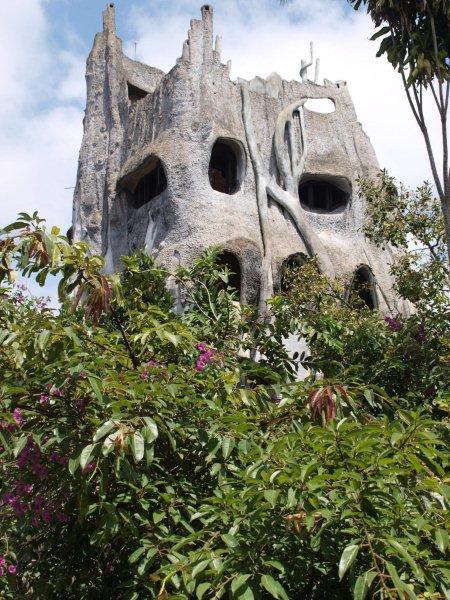
Dalat is also home to Hang Nga, known locally as ‘the crazy house’. It’s the work of 71 year old architect Mrs Dang Viet Nga and is a project that’s best described as Gaudi-esque.

With lots of colourful curved concrete, this tree shaped house with gothic back drop features a series of bedrooms, decorated in a surreal style.

The whole place is a work in progress – the day I visited the architect was visible on a distant roof, dressed black (but of course), wearing a traditional conical hat to keep off the sun and directing workmen on the next phase.

You can visit or choose to stay the night in one of the rooms...though frankly I would not find the staring eyes of that red cat conducive to sleep.

Monday, 31 May 2010

Beachside bliss

On Friday I lose my traveller cool. Not only do I have a raging case of PMT (never conducive to zen-like behaviour) but I also find out that I can’t take the train to my next destination: Mui Ne, a small resort on the coast some 300km north of HCMC. I have to climb back on the wretched bus, which then takes seven hours for a four hour journey.

We have a driver so laid back the bus doesn’t hit above 50km an hour for the entire seven hours and the traffic coming out of HCMC makes the M25 look like a peaceful country lane. We sit and splutter and stutter for minute after minute, hour after hour, and my mood goes from bored to impatient to frustrated to raging.

Finally we arrive. I have a list of requirements: beach side bungalow, air conditioned, no more than $15, must have wifi, preferably a garden and a pool. An older gentleman on a scooter says he knows just the place. I vow not to like it as I break my earlier vow and jump on the back (the traffic here is non-existent).

But in fact he delivers me to the perfect spot. I take one look at the room and begin to relax. I’m in my bikini within five minutes and in the sea within six. A few minutes later and I’m the master of zen again.

Frankly who wouldn’t be? Mui Ne is a sweep of beach some 10 miles long. Low rise bungalows (ranging from budget to swish) stretch along the shore, hidden by palm trees and gardens. There are beachside bars and restaurants and, thanks to daily on shore breezes, a whole community of buff kite surfers who’ve taken up residence. There’s one peaceful road running the length of the resort with more bars and restaurants stretched along it.

A local community of fishermen still use the beach and you can see their round boats bobbing around in the sea day and night. It’s the low season and it seems to me to be the perfect time to visit – enough people about to have a bit of a vibe but plenty of rooms and virtually no one on the beach.

I plan to stay for two days but end up staying four. I swim in the sea before eating breakfast at a beachside cafe. Then I lie under the shade of a palm tree, reading and dipping into the sea whenever I get too hot. The water is refreshing but warm enough that you can float in it till your fingers and toes are white and totally wrinkled. That’s pretty much my day, with the odd break for a little more eating and drinking.

I meet a fruit seller on the beach who tempts me with fresh pineapple and lychees. It’s 35C and though there’s a cool breeze the sun is beating down. She doesn’t seem to mind. She’s wearing two hats (a large cloth one covered by the traditional Vietnamese conical design), a face mask, two long sleeved blouses covered by a jumper and a coat (she proudly counts the layers out for me ‘one, two, three, four), trousers and flip flops with socks. ‘The sun is too hot for skin,’ she tells me; staying pale is preferable to staying cool.

One night I hook up with Lucy, an Irish engineer, and her Aussie boyfriend Todd. We drink beer by the beach (Todd setting a fearsome pace) and then wander along the strip drinking beers in any bar we fancy. We fuel up at La Luna, an Italian restaurant that delivers deliciously authentic wood-fired pizzas and then catch a cab to Samarra, a five star beachside club complete with tented white spaces in which to recline and a shimmering light show. We drink watermelon martinis and dance on the sand before walking home back along the beach.

Mui Ne feels like a tropical Ibiza at about a tenth of the price but if you fancy a visit come soon. The Russians have already discovered the resort (thanks to long links with communist Vietnam) and there are already plenty of upmarket restaurants and clubs (including a black and white vodka and sushi bar called Snow). The laid back surfer vibe might not be here for much longer.

Wednesday, 26 May 2010

How to cross the road in Ho Chi Minh City

Vietnam feels much more prosperous than Cambodia. On the Cambodian side of the border we stutter along a narrow two lane road with dusty verges and fragile skeletal bamboo framed homes right up on the roadside. In Vietnam, we're immediately on a four lane highway, with special scooter only lanes, landscaped central islands and pavements for pedestrians.

The houses are sturdy and painted; the general air of neglect and decay that typifies Cambodia (and lends it some of its laid back charm) is gone. As we enter Saigon (the central distric of HCMC) advertising hoardings, European brands, glass fronted shops and high rise blocks come into view.

There are hardly any bicycles in evidence either. Tuk tuks are replaced by taxis, buses and cars. In Cambodia, outside Pnomh Penh, cars are still relatively rare. They are so valuable that I once saw one parked inside a living room with six broad based wooden armchairs set on the edges of the room around it.

But after the tranquility of Cambodia, where even Pnomh Penh has a faintly rural feel, the traffic in HCMC is startling. Along with the volumne comes a disregard for rules of the road. Some people drive the wrong way because it's easier or more convenient, others use the pavement as a turning cirlce or shortcut.

What's even more startling is that you're expected to brave the chaos and cross the road. There's no point waiting for a gap in the traffic (there never is any) or a green walk signal (they are utterly ignored). You simply need to take your life in your hands, step out and walk.

The secret, believe it or not, is to walk very very very slowly. One tiny footstep in front of the other. This allows car drivers and scooters to estimate your position and take evasive action. They don't slow down much but they do drive round you.

The first two times I try it, I cross in the slipstream of locals, first a young student and then an elderly woman wearing (to my delight) the traditional conical hat. Neither deign to make eye contact with the traffic. They simply keep their eye on their destination and walk, very slowly but deliberately, into the road. At first I watch the cars and the bikes buzz by, but by the end of the day I too am staying zen-like and focused on my target. If nothing else, it's better for my heart rate.

Then I make the mistake of taking a moto home. It's been a long hot day and I don't fancy the walk. But 10 seconds into the longest 5 minute ride of my life, I'm utterly terrified. We whizz along, dodging and weaving. At one point the driver turns to chat to me. 'There are more than 4million scooters in HCMC,' he says proudly.

No kidding, I think, I can see about 3million of them right here, right now, driving straight at us. When I get off my legs are shaking and I'm perspiring with fear. The driver notices my hand shake as I take out the money to pay him.

He touches my arm and smiles. 'You get used,' he says. 'Not long, you get used.'

Not in this lifetime, I think and I swear to myself that I have taken my last motorbike ride between here and Berlin.

And here's a picture for those of you who work in health and safety or maybe municipal electrics. HCMC blows your mind (very possibly literally) with its wiring scheme!