Monday, 24 May 2010

Goodbye Cambodia

My last day in Cambodia and the country turns on the heat for me as the thermometer reaches 45C in Pnomh Penh. Combined with sweltering humidity I feel a bit like a roast dinner in a steam oven, cooking slowly and wetly.

In a bid to beat the heat, days start early here. From 5.30am the cafes are pulling up their shutters. Moto drivers stretch and scratch by their vehicles and sleepy eyed women are laying out their wares in the market: shiny green limes, pale pink lychees, the vibrant cerise of dragon fruit, the yellow green bananas and olden pineapples.

By 7am the day is in full swing. The cafes are filled with men, eating soup or drinking sweet coffee, their backs to the road watching the TV that is inevitably blaring away in a corner. Monks, one behind the other like a string of saffron, are walking the roads for breakfast and alms, offering sing song prayers of thanks and good health to those that oblige.

The children on the morning shift at school are pressed clean in white and navy, walking or cycling to class. In the market the women are chopping the heads of the fish and swatting away the flies, calling to each other, laughing and bartering. Street vendors with long bamboo canes balanced over their shoulders, finely balanced on each side, are walking and shouting up their business in the busy streets.

By mid morning the heat is cranking up the volume. In the dusty northern fields, wiry farmers follow scrawny oxen behind the plough, dust rising in eddies behind them. Chickens, long legged and delicate, scratch in the dirt and a cockerel gives a half hearted crow. In the river, men and women walk along behind fishing nets, shoulder deep in yellow water that is as tepid as a bath.

Scooters packed with people and goods buzz along the streets; one has the bodies of four pigs strapped sideways alongside the driver, their trotters bouncing forlornly as the bike bumps along the road. Four policemen squeeze on one bike; a young family, three children and their parents squashed close together, pass by and wave and smile.

At lunchtime the heat is unmanageable. Even the moto drivers have given up their tout for business and are parked under trees and lying across the back of the tuk tuk searching for sleep. The never ending traffic slows and stutters. Skeletal Brahmin cows, their skin the colour and texture of pebbles washed white by the sea seek whatever shade they can find.

A small breeze picks up and by mid afternoon the clouds are gathering, bruised blue black in the sky. A sharp breeze rises, dust spins into my eyes and sticks to my sweaty arms. My t-shirt is ringed with damp and dirt. One fat drop announces the rain storm the city has been waiting for and soon we’re engulfed in a deluge.
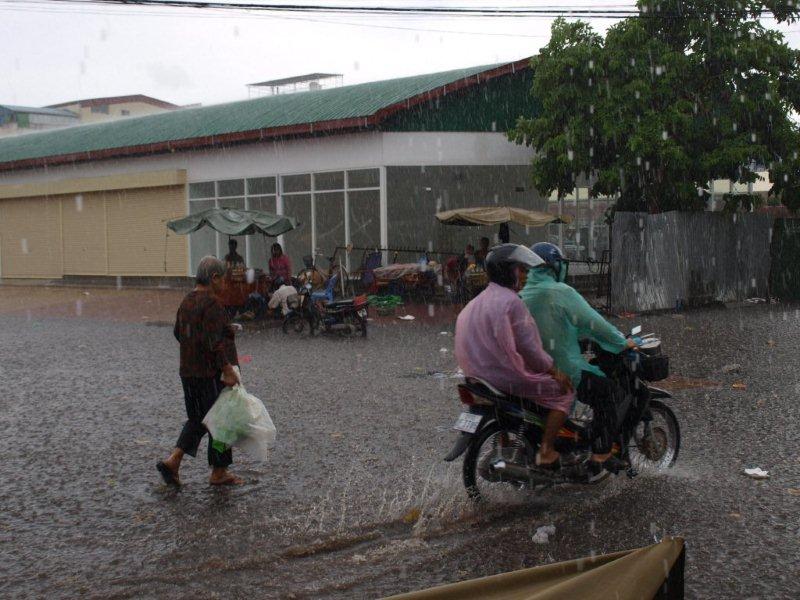
The streets become rivers; young children swim and splash and narrowly miss the wheels of scooters that splash by. Two young boys dance on a roof, hands in the air with joy. Almost as soon as it’s begun, it’s over again. The air has cooled a little but the humidity rises.

Finally the sun heads towards the horizon and the temperature becomes bearable. Workers start their commute home. The city is filled with the horns of a thousand scooters, bikes and the occasional shiny NGO-owned Lexus. Pedestrians and vehicles cross and turn and swoop and glide like partners in a chaotic but choreographed dance.

Along the river front, courting teenagers cruise up and down in the sunset light, the girls sitting side saddle on the scooters. In a park a group of shirtless men, shiny sweat sheened brown, play volleyball. Shopkeepers swing in hammocks, farmers rest on raised platforms and chat, a young mother washes a plump baby in a wide lipped earthenware jug.

The bars open and young girls in high heels perch on the arms of chairs. Beside them, old white men with the gleam of sweat on their pink heads, drink beer and pontificate. The restaurants and cafes fill. Men drink pitchers of beer and eat rice and noodles and wave their chopsticks around as they talk. Women sip ice coffee and tea and look cool in their silk or cotton pyjama suits.

By 10.30pm most are in bed; the heat is almost bearable. I lie spread eagled on my bed, under the fan, dreaming of winter.

The young ones...

Today I saw an old woman. Toothless, with wispy hair and a thousand wrinkles she leant on the arm of a younger man and walked slowly along the road. And it came to me suddenly how few old people there are in this country.

Everywhere you look you see children, teenagers and those in their 20s. According to statistics, 50% of the population is under 18. Looking around it feels as if another 45% are under 30.

Given Cambodia’s violent recent history it should come as no surprise. On April 17, 1975, the Khmer Rouge, an extreme Maoist/Marxist group, took control of the country. It wanted to turn Cambodia into a giant peasant based agrarian cooperative and emptied Pnomh Penh of people, forcing families to march from the city to the countryside. The entire population of the country, men, women and children, was forced to work, often up to 18 hours a day in the fields. Many starved to death, many more were tortured and executed.

During the 3 years, 8 months and 20 days of the Khmer Rouge rule, somewhere between 1.5 and 3million Cambodians were murdered or died (historians still struggle for an accurate count). This amounts to almost a quarter of the population. You can find out more here or here.

After the Khmer Rouge were disposed by the Vietnamese in 1979, they kept up a guerrilla war that didn’t end until 1991 and their last strongholds were not routed until 1998.

Looking around Cambodia today it feels as if two generations of people are missing. Not only the older generations who died in the 70s but also the generation of 25-35 year olds, who just weren’t conceived during those years of war and terror.

I visit the Tuol Sleng Museum in Pnomh Penh to find out a bit more. Formerly a suburban high school, the Khmer Rouge turned it into a security prison called S21. Classrooms became tiny prison cells and torture chambers. Of the almost 17,000 adults who were incarcerated here, only seven survived. Children were killed too. Those who survived the torture were bludgeoned to death to save bullets.

It’s a terribly distressing place, even today. The cells and torture chambers remain intact and in other rooms the pictures of those who were imprisoned here – the Khmer Rouge kept meticulous records – are on show. Men and women, girls and boys. Some look terrified, others bemused.

When I come out, the moto driver notices my mood. He’s 45, a few years older than me, with a worn face, only a small selection of his original teeth and the gentle smile that’s so common in this country. He looks 55, maybe more.

‘It’s a sad place,’ he says.

I nod.

‘My father, my brother and my uncle. They all died during that time,’ he says. Then with a little grimace of his mouth and a barely there shrug, he turns and kick starts the bike.

Sunday, 23 May 2010

Food, glorious food


Cambodian food is, as you’d expect, a cross between the chilli and lemon grass flavours of Thai cookery and the oyster sauce stir fries and herb filled spring rolls of Vietnam.

My favourites are the eye wateringly hot soups, clear broths for the most part, usually fish based and filled with lemongrass, lime, chilli and garlic. I also like the herby fresh spring rolls – mint, basil and coriander mixed with bean sprouts, prawns and rice noodles and dipped in a garlic, chilli and fish sauce dip. Yum, yum and yum again.

Yesterday I had the chance to take a day’s cookery course with Siolahn, a local woman who teaches westerners Cambodian cookery. She’s in her 30s, plump and round with dimples in her upper arms and sturdy short legs. Entirely capable, she can chop, pummel, twist and style an entire dish in the time it takes me to tidy the corner of my first spring roll.

Siolahn watches our attempts with much the same look that you have when you watch children learn something. Every now and then she can’t help herself and pops round to fix and improve our sorry efforts. You can see that she makes these simple dishes every day and still can’t comprehend that we struggle to cook them and, even more incomprehensibly, that we offer to pay her for her help.

She tells me she comes from a farming district in the country’s east. Until three years ago she worked in the fields and looked after her family. ‘We didn’t see any tourists there and it is a very hard life, very hard to earn money,’ she says. ‘My friends told me that there were a lot of Westerners in Sihanoukville and good jobs with good money, so my husband and I moved down here.’

And for once it seems the stories of a city paved with gold have turned out to be true. When I ask her if she likes it here a huge smile spreads over her face. ‘I will never go back. There are so many tourists here.’

It was a fun day and at least in theory, when I get home I’ll now be able to host a Cambodian dinner party. The menu? Seafood soup followed by summer spring rolls, then Lok Lak, a peppery beef stir fry served with rice and a fried egg for main and sticky coconut rice with mango for dessert.

For those who’d rather make something themselves than wait for a dinner invite from me, here’s the recipe for the seafood soup. It takes about 15 minutes to make from start to finish and is a great way to blow the cobwebs away with a hit of chilli, garlic and lemongrass.

Seafood soup with lime and fresh herbs (serves 4)
Ingredients:
-White fish – any type but ideally one that doesn’t break up too easily, 400grams, cut into 4 pieces
-Squid and prawns (at least a couple of pieces of each per person)
-Fish stock (about 1 litre, make up as you prefer)
-1 small tablespoon rice
-2 stalks lemon grass, crushed
-Thumb size piece of Galangal, peeled and crushed
-2 kaffir lime leaves
-4 cloves of garlic, finely chopped
-1 ½ teaspoons salt
-Basil (a small handful, torn)
-Saw mint (8 long leaves) – if not available use coriander, a small handful
-Spring onion or two cut finely
-2 red chilli (reduce if you prefer less heat) finely chopped, including seeds
-Juice of two limes
-2 limes, quartered, for serving

Method:
-Add the tablespoon of rice to the stock and bring stock to boil.
-When boiling add crushed lemongrass, garlic, galangal, lime leaves (torn) and salt.
-Simmer for five to 10 minutes.
-Add fish. Cover pan, reduce heat and simmer for 5 minutes (fish should be cooked).
-Add seafood and simmer for 2 minutes (or until cooked).
-Divide torn herbs (basil and saw mint), spring onion and chilli between 4 bowls
-Ladle soup (including lemon grass etc) over the herbs, season generously with lime juice and serve with half a lime (add to taste). Cambodians don’t eat the lemongrass or galangal but it’s perfectly acceptable to chew and suck on them for taste and then leave them in the bowl.
Note: if you’re making this for fewer people you can halve the ingredients for two servings but not quarter for one as you’ll lose taste. My advice: make two servings and eat it the next day!

Thursday, 20 May 2010

Trouble in paradise

I wake to find the mosquito net billowing about me. I raise my head and see Hannah kneeling at the foot of the bed.

‘What are you doing? Why are you messing with the net?’ I’m half asleep still.

‘It’s not me, can’t you feel the wind?’ she sounds a bit harried.

It’s the middle of the night and I’m not in the mood to wake so I lie back down again, but a sudden crack of thunder over head forces me to open my eyes just as a sheet of lighting brightens the room to virtual daylight. Dazed I sit up.

There’s lighting on every side, huge bright sheets that seem very close. Claps of thunder follow the lighting with impressive speed and the wind whips up and up, faster and faster until it’s roaring around our ears and the net is whipping into our faces. The hissing sound of rain on the roof announces that the storm is well and truly here.

I’m fully awake now. We’re in the centre of a massive tropical storm and we’re sleeping in a tree house, some 10metres off the ground (the perfect lighting rod, I think to myself) and open on three sides to the elements.

It seemed idyllic when we arrived this morning. On a secluded bay on the island of Koh Rong, some 2hours by boat from Sihanoukville, we’re the only guests at this virtually new guest house; the owners, local girl Nuch Ros and her Turkish husband Bora Ozturk, are still building the restaurant and other bungalows.

We are also the only passengers on the boat overnighting here and when we step off onto the rickety pier by the tiny fishing village that calls this bay its home, we walk along a mile long curve of white sand bordered by turquoise blue sea to get to the cottages. The sky is a deeper shade of blue and the island itself a tropical green.

At the end of the beach we turn off into the undergrowth, following a faded path for another 100 metres and find ourselves on a smaller bay and at the foot of the tree house. There are 10 steps to the shower, which also has beautiful views of the seat, and another 12 to the bedroom. It is utterly peaceful; all we can hear is the soft rush of the sea as it runs in to greet the sand.

We spend the day swimming in the sea, lying on the shade in the sand and resting in the tree house. With sea views on three sides and high enough to catch the breeze it’s a blissful spot to lounge.

Nuch and Bora invite us to join them and their friend Srey Ra for dinner and we sit on the raised platform that serves as their kitchen, ducks, chickens and geese scratching around below, and eat fried rice, hot chips (cooked especially for our western palate) and the most delicious aubergine and beef dish. Thick as paste it is smoky, spicy and very moreish.

At 9pm the generator is switched off so we have an early night. The heat is astounding, 38C perhaps. There’s not a breath of breeze and the hot air sits on us like a heavy blanket. In the far distance the night sky offers a light show as lighting flashes across, sometimes in huge sheets, other times forks that connect the clouds and very occasionally a bolt that strikes the sea like a trident thrown by an angry god.

But now, some two hours later, the temperature has dropped, is dropping by the minute and the room feels almost chill. Our towels and bikinis, which were drying on the rail outside are billowing. I make a dash for it, lighting illuminating the way and rescue what I can. My bikini top and a towel have already blown into the night sky. The rain is pelting down and in through the windows. I'm wet and the edge of the bed is already damp.

We sit and watch the storm attack from three sides, thunder clapping directly overhead, lightening with a photo flash brillians. It feels as if we’re sitting in the clouds themselves. The trees around us sway and bend and thrash. The house creaks and it dawns on us that the tree house is new, it hasn’t yet survived a wet season.

‘Do you think it will be alright?’
‘Should we climb down?’

We giggle a little hysterically but sit tight. The house is sturdy and the storm is just a storm not a typhoon or cyclone. But up high, exposed, it feels first exciting, then nerve wracking and eventually tiring. When the wind finally lets up, an hour or more later, we crash into a relieved sleep and in the morning the island is as beautiful as ever.

The sea is crystal clear, the sky blue. We retrieve my bikini from the bushes nearby and spot the towel, high in a neighbouring tree then go for an early morning swim. We are the only people on the beach, virtually the only visitors on the island. It is a magical and peaceful paradise.

Later Nuch tells us that the island has been bought by an Australian consortium. There are plans for an airport and a large resort but these have been put on hold because of the global financial crisis. It seems churlish but I sincerely hope they never get it off the ground.

Monday, 17 May 2010

Bamboo train

Travelling by train in Cambodia was popular during French colonial times but both track and rolling stock were destroyed during the Khmer Rouge era and the war that followed. As you travel through the country you see abandoned train lines crossing roads and fields, weeds and trees growing among the sleepers.

But just outside Battanbang in the country’s north west, it’s possible to travel 135km through fields and rice paddies on the bamboo train. Making use of a section of rail that remains in relatively good repair, bamboo trains are ingenious little contraptions that move people, produce and even livestock. Hannah and I hire a tuk tuk and motor out to give it a try over 15km or so.

Each ‘train’ is nothing more than a bamboo frame of about 3m long by 2m wide. The frame sits on two detachable axles and is driven by a small motor. Around 30 people share ownership of the frame, each person taking control for one day of the month and making a living based on the number of rides they can generate on their day.

We find a spare train, sit ourselves on its bamboo frame and get started – it’s a bone shakingly uncomfortable ride that feels like a fairground attraction as it hurtles down the hill, rattles over a bridge and tilts precipitously round a corner. I lean in to avoid branches whipping by. Beside us are the arid rice paddies of the dry season.

We rattle on for half an hour or so until ahead of us another train carrying 10 locals slows at a stop and we pull in behind. A third train carrying a vast load of wood is coming the other way and by the rules of the line both passenger vehicles need to give way. When two trains meet, the lightest must dismantle – removing the bamboo tray and lifting the axles and wheels to the side – to let the heavier pass.

For our train this is simple, carrying just the two of us and our little bags it takes less than a minute, but the train in front is loaded up with bags, baskets, people and even a motorbike. After ten minutes or so it’s fully dismantled. The train carrying the wood moves slowly past and behind it the other train is being rebuilt, with chat and general good will all round.

This unique method of transport is on its last legs. Late last year a project began to link Pnomh Penh to both Bangkok and Ho Chi Minh City by rail. Slow progress is being made and once it reaches Battambang the bamboo train will be no more.

Thursday, 13 May 2010

Water ways

I leave Siem Reap at 6.30am to catch a water taxi to Battambang. The boat is 10m long with bench seats on either side. There’s just about enough room for two adults to sit opposite each other, with backpacks squeezed between our legs. The sides of the boat are open to the air and a soft breeze keeps us cool. It’s a nine hour journey to Battambang, through the rivers and tributaries of Tonle Sap, a vast lake in Cambodia’s north.

We start in a tiny stream, laboriously negotiating the shallow muddy water, grounding on sandbanks twice; the engine screaming and straining, the skipper shouting instructions to the boat boy as he reverses us back afloat. After an hour or so the river gets deeper and wider and soon we’re on the lake itself. We skim across the point where it is at its thinnest but even here land soon disappears so that it feels like you’re travelling across an inland sea.

Eventually, at some invisible marker, the helmsman turns the boat and we head down a wide river and find ourselves among floating villages. Everything is based around water here. Men fish from narrow boats, others walk in groups of three or four, pulling a net behind them, shoulder deep in water.

Women squat on boats loaded with produce – limes, bananas and herbs – and trade with floating stores. Others wash clothes or dishes in the yellow green water or cook on the verandas of their house boats.

Children, wet and slick like brown seals swim in the river, laughing, shouting hello and waving enthusiastically. All the houseboats and narrow boats are brightly coloured: blue, white, red, green and pink.

Occasionally someone signals the skipper with a wave and the taxi slows to a stop. Passengers row out to the boat, load up their luggage and squeeze in. By 11am we’re crowded together and every new arrival surreptitiously checks out the foreigners in their midst.

Two young brothers squeeze up beside me. They whisper behind their hands and giggle and nudge one another. Eventually the younger of the two gathers up his courage and asks ‘what is your name?’ I tell him and ask his in return. He is Chong Ler, he tells me, and his brother is Chong Lim and they spend the rest of the trip sharing their sweets with me, teaching me to speak Khmer and pointing out everything I need to see.

As the day wears on the heat rises and the river narrows. The smell of the water, a rich muddy scent flavoured with diesel and fish, grows stronger. Reeds and trees line every bend, cane crab pots sit low in the mud and the skipper ploughs a furrow deep through the centre of the river.

Eventually the houses of Battambang appear, scattered at first and then more dense and the river bank grows higher and higher. Each house is built on rickety stilts. Now, late in the dry season their bare legs are exposed as they stand and wait for the rising water to wrap them in its soft wet curtain of modesty.

We draw up and deposit passengers at makeshift back yard piers along the way until the final stop, when only tourists are left and we heave out our backpacks and climb rickety metal stairs to street level.

Saturday, 8 May 2010

All templed out at Angkor Wat

The sun rises to the snap and click of camera shutters. I can hear someone breathing in my ear and there's a bump on my elbow as we jostle for position. I’m at Angkor Wat trying to capture sunrise over this ancient monument but right now it feels more manic than magical.

We left our guesthouse at 5am and joined a convoy of mini-buses, tuk tuks, motorcycles and cyclists heading out to the temples of Angkor Wat. Our tuk tuk turns out to be the slowest in Siem Reap. Laughing and pointing, tourists overtake us one by one. At one point I’m sure I see a cyclist go by.

By the time we arrive at the temple, the sound of revving engines and guides directing groups in several languages almost drowns out the birdsong. Then the sky turns from grey to orange and pink and the famous curved pine cone-like shapes of the temples emerge from the gloom.

We walk away from the crowds, deeper into the complex and the mysticism of the space starts to come alive. Angkor Wat is the main temple of what was once the city of Angkor. Built in the 12th century, its symmetry rivals that of the Taj Mahal and in terms of majesty and scale Angkor Wat is the more impressive. Surrounded by greenery and almost deserted once the sunrise crowd has departed, it is peaceful and spiritual.

But it’s also only the beginning of a nine hour exploration of this amazing area. After a breakfast of pancakes and sweet coffee by the side of the Wat, our driver Lim takes us deeper into the reserve and we pass abandoned temples at every turn, the jungle encroaching, their walls tilting and toppling.

We motor up a long avenue alongside cars, buses and a lumbering elephant and an intricate gate rises out of the jungle, a line of Buddha heads leading us in. We’ve arrived at the south gate of Angkor Thom and just one turn away is the awesome Bayon temple.

Created as a monument to a king (whose face adorns every side of this multifaceted ruin) Bayon soothes the heart and mind. When I emerge among the stones and effigies, I feel as if I’m in a Raiders of the Lost Ark movie; Hannah says it reminds her of a Tintin story.

A tiny old woman, almost toothless, beckons me into a small stone shrine. Incense hangs heavy in the hot air. A stone Buddha is wrapped in an orange shawl, bright in the gloom. She smiles at me, prays for long life and happiness, wraps a red twine bracelet around my wrist, all the while murmuring a Buddhist chant and finishes by gently stroking her fingers down my hand.

It’s only 9.30 and already the temperature is at full blast. Sweat is running down my face and between my breasts and heat radiates from the stones. Click, click, click, click; all around me is the sound of a thousand photos being taken.

We carry on exploring, finding carved elephants, beautiful dancing girls in stone relief and everywhere the jungle encroaching on ruins. When the heat overwhelms us we sit in the sultry shade and drink cold, fresh coconut juice.

Much later Lim drives us to Ta Prohm, the scene of the Tomb Raider film and perhaps the most atmospheric site of the day. Maze like, it entices you in. High above us trees grow, seemingly out of stone; stone pieces block our way; toppling walls are covered in pale pink and green lichen.

By 1pm the heat is unbearable. In one dark corridor two men collide and there’s a moment of temple rage – muted shouting, rumbling disagreement dulled as they emerge again into the flaming, baking light of the day.

We decide we’re all templed out. Slow, laboured steps take us back to the tuk tuk. We ride into town with the hot air, like a blast from an oven, chafing at our faces and lips. My skin is sticky with dust and sunscreen and sweat but my mind is entranced: Angkor Wat is one of the most amazing places in the world and I feel privileged to have seen it.