Saturday, 8 May 2010

Bangkok to Siem Reap, Cambodia; 400 miles, 9 hours

There’s a thunder storm crashing on to the roof of Bangkok’s Hualampong station when we pull out at 5.50am for the border town of Aranya Prathet, a six hour ride away.

I’m sitting in 3rd class hard seats (wooden with stiffly upright backrests) and the fare is 48baht, less than £1. I haven’t had time for breakfast but at the first stop a team of women get on, each selling some kind of food – fragrant fried rice, hot sweet and milky coffee, cold soft drinks and parcels of sticky rice – from a basket on her hip. Fed and sated, I doze and watch the scenery go by and chat to two other travellers, Kaili from the US and Mark from England.

We arrive at 12.10. I’m hot, tired and feeling moody. By 2.00pm my mood hasn’t improved. From Aranya Prathet there’s a 6km taxi ride to the border, a horde of touts to avoid, several long immigration queues to be negotiated and a small ‘tip’ to be paid to Cambodia’s visa office. Finally, after a frustrating two hours, made worse by the burning sun and sauna like conditions, I’m over the border and sharing a taxi to Siem Reap with Kaili, Mike and Mark. Since Pol Pot and the Khmer Rouge there are no train lines running in Cambodia, so for the next few weeks it’s back to car, bus and boats for me.

It takes two hours to drive the 150km to Siem Reap and it quickly becomes obvious that Cambodia has yet to share in the prosperity that’s now in evidence in Thailand, Malaysia and Singapore. Roads are rutted and pot holed; small shanty towns line the side of the highway and the wind blows dusty eddies along the arid rice fields on both sides (the wet season has yet to start).

Siem Reap itself is surprisingly touristy: large hotel chains line the road into town. A small, sluggish brown river winds its way through the centre of town, French colonial homes (wide verandahs, high ceilings and lazily turning fans) sit beside more rickety constructions. The streets are surprisingly empty of traffic.

In the centre of town, beside the old market, runs a laneway that’s filled from end to end with restaurants. It feels like Ibiza town. Tables and chairs crowd the pavements, music spills out into the hot night, waiters tout for business and tourists sit sipping 50c happy hour pints of beer and eating everything from fried rice to pizza. The combination of the exotic and the everyday gets even stronger when my friend Hannah arrives from London to join me for two weeks. Siem Reap suddenly feels somehow very familiar.

I sit down for a very welcome cold beer – the first icy mouthful going a long way to soothe my travel sore body – and a group of small children cluster around me selling bracelets, postcards and other trinkets. They’re a constant feature of any stay in Siem Reap and their persistence and poverty make them very hard to refuse.

One lunchtime a young boy tries to sell me bracelets. I show him the set I bought the previous day. He looks at me with doleful eyes. ‘Can you buy me something to eat?’ he asks quietly. We buy him and his friend a lunch of fried rice and they eat, quickly, quietly, beside us then tidy away their plates and say thank you and polite goodbyes before heading off to sell some more. I feel wealthy, guilty and thankful for all I have.

Wednesday, 5 May 2010

Storm in a teacup: Penang to Bangkok, 946km, 22 hours

So it turns out I don't need to be Kate Adie. By the time I arrive here the Red Shirts and Thai government have reached an amicable agreement (for the time being anyway). Life in the capital seems to be back to completely normal - huge exhaust filled traffic jams, the scent of roasting meat and Pad Thai from numerous street restaurants and more Tuk Tuk drivers than you can shake a stick at following you around asking 'taxi, taxi, you want taxi?'.

The only thing conspicuous by their absence are tourists. I meet Renske, a Dutch girl who's also travelling to Bangkok on the train and we check into a hostel together. We're the only guests they have and as we wander around the city in the afternoon we see maybe half a dozen other travellers at most. (If you're ever doing this route or want to stay somewhere near to the railway station in Bangkok, Baan Hualampong is a great choice. It's an old Chinese house with wood and tile floors, heigh ceilings and Chinese style wood panel walls...very atmospheric, totally clean and only 5 minutes walk from the station).

The 'avoid at all costs' travel advice issued by various governments all seems a bit of an over reaction now that I'm here.

Renske and I stumble on one of the protest sites. It's almost empty and has the feel of the last day at a Festival. The ground is littered with water bottles and drink cans, there's a small stage with a folorn banner, some young guys sleeping in the shade and a few little red flags still waving.

One traveller we meet tells us that until yesterday the space was filled with men, women and children in what he describes as a 'festival mood'. They offered him free food and he sat and chatted with them for an hour or so. The police presence, at least at this site near Koh Sahn Road, was low key.

The train journey to Bangkok was fab. Air conditioned carriages with generous seats turn into large bunk beds at night. It's £2 extra for the bottom bunk but it is a third or more wider and much more comfortable than the one above, so be sure to ask for it if you ever book a sleeper in Thailand.

After we cross the Thai border a dinner menu is handed out and served at your seat. I have soup, prawns with vegetables, chicken green curry and fresh pineapple, along with a large cold beer for £6. Then I sleep like a baby till the sun comes up and the stewards rattle the curtains that separate the beds from the corridor to wake us up.

The most interesting passenger on this trip turns out to be 8 years old. His name is Gabriel and he comes from Louisianna in the USA. He's the youngest of 15 children and his mum died when he was 4. He now lives with his father, who is ex US Army and sports a large beer belly and long black hair and trades diamonds for a living, in a guest house in Bangkok along with his step mum, a lovely and very quiet Indonesian woman.

Gabriel talks non-stop. He tells the entire carriage his life story, his father's life story and shares with us his views on subjects ranging from Alexander the Great (apparently the greatest leader of all time and a great great great to the trillionth relative of his) to the Latin Kings (his Dad 'hurt two of 'em real bad one time. He didn't shoot 'em cause he didn't want to kill 'em but he kicked their asses.').

He tells me his cousin killed a man with a razor blade; his older brother got him drunk for the first time (for a joke) when he was 5; his Dad always carries at least one gun.

Gabriel speaks three languages (English, Thai and Indonesian). He seems very articulate for his age and supremely confident. Combine that with the pugnacious mindset of the deep American south and you have an extremely interesting (or perhaps challening) mix. I bet we see his name in the headlines, one way or the other, sometime in the future.

Tuesday, 4 May 2010

Singapore to Penang, 18 hours, approx 1,000km

Have spent the last two days travelling up the Malaysian Penninsula - 8 hours from Singapore to Kuala Lumpur where I spent the night then another 8 hours from KL to Butterworth, where I spent another night.

Singapore to KL wasn't so interesting for most of the way the jungle has been cleared to make room for mile after mile after mile of palm plantations. They're souless when compared to the natural environment they've replaced.

From KL on it gets better. The train runs along the foothills of the Cameron Highlands and the steep slopes are covered in tumultous jungle, a hundred shades of green. The mountain tops are shrouded in brused grey clouds and occasionally we drive into the edge of a monsoonal downpour and fat drops commit hara kiri on the window panes.

Brightly coloured houses and vivid temples are glimpsed for an instant then vanish again into the green. We cross green brown rivers and wet fields. Chickens scratch in front gardens and silky looking Brahman cows cool themselves in muddy pools. Small ponds sport water lilies the size of dinner plates with pale pink flowers waving above them.

The man sitting next to me is nearly 80 and is thin with old age. He snacks on poppadoms, breaking them daintily in his fingers. When he bends forward to pick the next one from his bag, I see the soft skin on the back of his neck and across his ears is a velvety soft mocha.

Despite the fact that the trains here are comfortable - air conditioned, lots of leg room - and it's been super easy making reservations (you just email the booking office, they confirm your seats and you pick up and pay for your ticket the day before you travel), I seem to be the only European tourist on the train.

The internet has really made trips like this a doddle to organise yourself. If you're planning a train journey anywhere take a look at Seat 61. It's an encyclopedic resource for booking train journeys anywhere in the world run by a guy called Mark Smith (the man in Seat 61). I like his advice: never travel without a good book and a corkscrew.

Today I'm off to Bangkok on the over night sleeper. Am feelig slightly apprehensive given all the Red Shirt protests. Clearly I'm no Kate Adie (a BBC war correspondent for non-Brits reading this). Wish me luck!

Sunday, 2 May 2010

What shall I eat next?

There are two main pastimes in Singapore: shopping and eating. Given that my backpack is already bulging out of its expandable top, I choose eating.

You can eat well and cheaply here 24 hours a day from markets, food courts and restaurants. And with culinary options from China, India and Malaysia (among many others), there’s so much choice it’s hard to know where to begin...or end for that matter.

Here’s a list of what I manage to consume in a day:
-2 slices of toast at the free hostel breakfast
-a bowl of prawn noodle soup
-a cheese and onion Parata – an Indian style pancake
-a fresh coconut (for the juice)
-two slices of melon
-six little Indonesian sweets (made from sago and coconut – a curious mix of sweet and salty, -kind of like jelly and bright green)
-a steamed bbq pork bun
-a very large beer
-roast chicken and rice

All of that costs me the grand total of $20Singapore – that’s around £10 – and all, with the exception of the soup which was a bit bland, was really yummy. It’s lucky I’m only staying one day or I’d be bursting out of my non-expandable top pretty damn soon too.

Around 6pm, when I take a little walk to work off some of what I’ve eaten and build up an appetite for more, Singapore charms me once again.

I stumble on a public square, right in the centre of Chinatown, where a big crowd are indulging in the local version of line dancing. They dance in unison to tunes ranging from the 1950s to last year and can I tell you, you haven’t seen anything till you’ve seen 100 middle aged Singaporeans dancing suggestively to Pussycat Dolls Don’t Cha. ‘Bet you wish your girlfriend was hot like me,’ they sing along, as they bump and grind it.

Some are dressed up (check out the matching cowboy boots, hat and shirt of the couple in the front of the picture) but plenty are just wearing jeans and a t-shirt. They know all the moves to something like 50 songs (I don’t stay that long but I do check out the song list before I go).

They’re dancing in front of an old Chinese temple so I stick my head round there before I wander off. A huge gold sitting Buddha, with a multi-coloured bejewelled halo, casts a benign eye over me. Wisps of incense smoke floats around my head and it feels as though Singapore is blessing my journey.

Friday night Singapore style

Flying into Singapore on a Friday evening is invigorating. On the left of the plane, the city stands confident, bathed in light. Skyscrapers reach glass and steel fingers into the sky. On the right, in the dark bay, a vast flotilla of cargo ships, a hundred or more, form a queue waiting their turn to unload and collect at Singapore’s port. Their lights, flickering red and green resemble a long weekend motorway traffic jam.

The airport itself is a buzz of energy – shops and restaurants are open and busy serving staff and passengers. An orchid garden is signposted on the right, a food court further on. The aircon is cool, the directions clear, everyone is moving.

I find myself in the flow of people heading for the metro system and like neat little bottles on a conveyor belt we ride the escalators then find staff on hand to provide advice, assistance and even small change for the newly arrived.

The trains themselves are new, spotlessly clean, air conditioned and filled with a cosmopolitan crowd. Young super stylish kids play with i-Pods, phones and games, then stand for an old Chinese couple who lower themselves slowly onto their seats. Two Indian women, one in an iridescent sari reminiscent of a peacock’s tail, stand by the doors adding a touch of glamour to the carriage.

It’s midnight when I emerge into the heat in Chinatown, where I’m staying. Everything is open – stores, restaurants, bars. Music beats loud from storefronts and there’s a smell of incense in the air. People are browsing, eating, shopping, chatting; all calm, all relaxed, not a drunk or a burger wrapper in sight.

I think of what the same experience might be like arriving into Heathrow late on a Friday night and the contrast is a little shaming.

Saturday, 1 May 2010

The Tiwi Islands

Bathurst Island sits, jungle green, in the turquoise sea. Along with Melville Island, just across the water, it is the traditional home of the Tiwi people and remains an indigenous community that outsiders are only allowed to visit with permission from the traditional land owners.

The ferry from Darwin, an hour away to the south, slows as it approaches, then winds its way up an estuary lined on both sides with deep mangroves and, to my mind, the bulbous watchful eyes of large crocodiles.

It anchors off shore and a small boat bounces out to meet us. We clamber on and, spray in our faces, motor towards the beach, sliding onto the sand with surprising speed. The ferry terminal is a large shed brightly painted in the local style: red, yellow and white ochre whirling in gentle patterns.

Phil has been sent to meet me and drive me the 80km to the outstation of Ranku where I’ll be staying. But first we check out Nguiu, the capital. Home to 1,500 people it has a slightly desolate air. Gardens are overgrown, litter is caught in the long grass, skinny mangy dogs yelp as they chase the tyres of our Landcruiser. On vacant lots and in gardens, groups of people sit in circles on blue tarpaulins under the trees, concentrated and engrossed. Children weave among them, most holding large bottles filled with vividly bright soft drinks.

‘The 3 G’s,’ says Phil when I ask what they’re doing. ‘Gambling, ganja and grog.’ Alcohol is severely restricted but marijuana use (despite its illegality) is a growing issue. And gambling is a favourite pastime. Each blue tarp is a mini casino where a game of cards, sometimes with stakes in the thousands, is taking place. ‘Whoever provides the tarp, along with a tap for water and maybe access to a toilet gets $400 a day,’ says Phil. ‘I’ve heard of people winning $15,000a game. It’s big money.’

We pull up to visit an artists’ collective locally known as ‘the Sistine chapel’. Run by Joy and John, who have lived on the island since 1994, the collective buys work from local carvers and employs 13 artists working across woodprint, painting and batik. It produces highly collectable work in the distinctive style of the Tiwi people, very different to the dot and rock paintings of central Australia. Carved and painted birds, their long necks reaching to the sky, hand printed scarves and vivid ochre paintings are on display and when you tilt your head to look at the workshop ceiling it becomes obvious how the group has earned its nickname.

Eventually Phil drags me away and we set off towards Ranku. As we leave Nguiu, the only paved road on the island abruptly terminates and we find ourselves on a dirt track, winding like a rust red river between the rich green foliage on either side. Sometimes dry, dusty and corrugated then, around the next corner, washed away into deep gullies filled with squelching mud, it’s a slow, bumpy ride. The four wheel drive comes equipped with a winch and inflatable jack for those days when it gets bogged and a chain saw with which to cut away trees that have fallen and blocked the track.

After an hour of jolting along we come to a sign: Welcome to Wururankuwu and a clearing. A dozen, maybe more houses, are loosely clustered here. The grass is mown, there’s a children’s playground and village feels welcoming and cared for.

I meet Stewart and Rin, my hosts and we sit under a lazy turning fan. As the heat of the day cools, Stewart takes me to a local waterhole for a swim. Sandy bottomed and clear, the water tumbles down a small water fall and is fast running and deliciously cool. We dive in with a whoop and float for an age, until I’m finally, and for the first time in many days, cool to the core.

The next morning Stewart takes me on a tour of the island’s deserted and pristine beaches. We bump and jolt our way along muddy paths through rainforests of gums, palms and huge ferns, till out of nowhere the sand and blue horizon of the sea appear. Lined by cliffs in vivid colours there’s something ancient and awesome about this place: it feels as if few people have ever walked here.

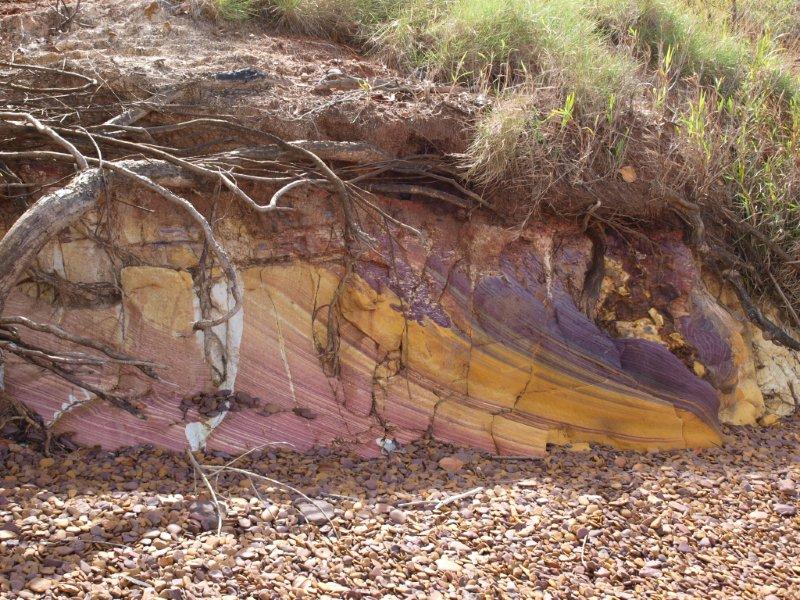
Run your hand along the cliffs and you discover that the vivid colours are clay that you can smudge and paint with. ‘Since I’ve seen this place I feel I understand the local art so much better,’ says Stewart and I understand what he means. The colour, the pattern, the rhythm of this place finds a distant echo in the art and sculpture of the island.

That night we eat fish, freshly caught by Stewart and Rin. It is sweet and utterly delicious. Before dinner I sit in the club and have a beer with three of the locals who are quietly enjoying one of their regulation six beers. They ask my name and welcome me with an easy camaraderie that feels utterly natural; making no concession to my foreignness they simply include me in their conversation as if I’ve always lived here and know the people and issues they speak of as intimately as they do. It's unforced, without pretension and very relaxing: no questions to be answered, no expectations to be met.

In the morning I visit Ranku’s tiny primary school. It has nine pupils aged between 5and 11, two preschoolers and two teachers. The kids are generous with their smiles and hugs. They ask me questions about London, sing a song for me, show me their paintings and give me two to take away. But some of them are facing pretty big issues. One nine year old boy's father committed suicide two years ago; two sisters, aged 9 and 11, are being looked after by extended family after their mother brought them over from Darwin and left again; a third boy has a broken arm and empty eyes. He's the only one who doesn't smile all morning. There's hope here but it's tempered by reality.

As I prepare to leave, the village is still in the rising heat of the morning. Two women walk from the store carrying bottles of bright orange soft drink and chatting softly together. They see me, smile wide and welcoming and greet me with a wave. I feel as if I’ve lived here for months and a genuine wrench at leaving.

The Intervention

Imagine an estate where unemployment is the norm, poverty, alcohol and drug addiction are rife. Child neglect and truancy are common and then a case of child abuse is discovered. The government acts.

Benefits are no longer paid in cash, instead a Basics card is issued that can only be used for groceries and other basic needs. Alcohol is banned (unless you have a permit, which is difficult to obtain). and residents are searched whenever they enter the estate. They are limited to visiting a pub between 4.30pm and 7.30pm, four days a week, when they are not permitted to drink more than six bottles of beer. Pornography is declared illegal. In order to implement these rules the Human Rights Act has to be suspended.

Sounds draconian. Sounds like the kind of thing a government would never get away with? Well they do in Australia; but only in the Northern Territory and only in indigenous communities.

The programme is called the intervention and I’m about to visit one of the communities affected: Bathurst Island, one of the Tiwi Islands in the far north of Australia.